

Policy
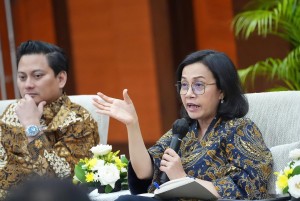
Sri Mulyani defends BPS’s Q2 2025 GDP growth data
Finance Minister Sri Mulyani Indrawati has come to the defense of Statistics Indonesia (BPS) against growing skepticism from economists over BPS’s report on Indonesia’s second-quarter economic growth figure of 5.12 percent year-on-year, released earlier this week.
No more bonus for SOE commissioners in push for reforms: Palace
The Presidential Palace has confirmed that the government's decision to eliminate tantiem (bonus) payments for commissioners of state-owned enterprises (SOEs) is not a punitive measure but rather a structural reform to strengthen the governance and integrity of Indonesia’s SOEs.
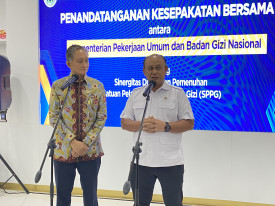
Government sets goal to expand nutrition service centers nationwide
The government is taking measures to speed up provision of nutritional access across the country, targeting the construction of 1,542 Nutrition Fulfillment Service Units (SPPGs) by the end of 2025.

Indonesia urged to revise green taxonomy to support credible low-carbon industry
Indonesia's current green finance taxonomy risks undermining the country’s ambition to lead the global green industrialization race due to its lenient treatment of mining and coal-fired power sectors, according to a new report by the Energy Shift Institute (ESI).
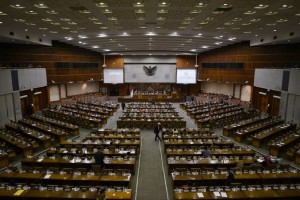
House Commission chair: Criminal Code Procedure bill not to weaken KPK
Chairman of Commission III of the House of Representatives (DPR), Habiburokhman, has ensured that the Draft Criminal Code Procedure Code (RUU KUHAP) would not weaken the Corruption Eradication Commission (KPK).
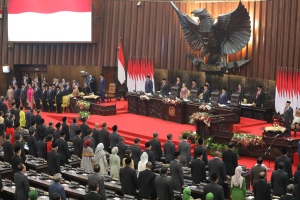
Draft Code risks undermining anti-corruption efforts: Civil society coalition
The Civil Society Coalition has raised alarm over the Draft Criminal Code Procedure (RKUHAP), warning that several provisions under discussion in the House of Representatives (DPR) pose serious threats to the independence and effectiveness of the Corruption Eradication Commission (KPK).
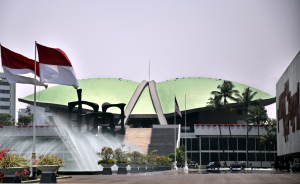
House criticizes Danantara’s project management, warns of strategic, fiscal risks
Trade and SOEs Commission VI of the House of Representatives raises concerns over the effectiveness of Danantara, a newly formed state-owned investment holding, in managing key national projects as the majority of its 21 priority projects remain entangled in financial, structural and business model issues that undermine its vision of stabilizing and optimizing state-owned assets.
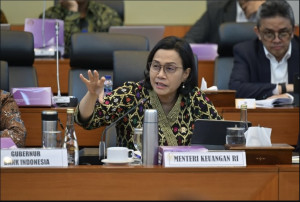
Finance minister defends fluctuating education budget allocation amid criticism
Minister of Finance Sri Mulyani Indrawati defended the government’s handling of the education budget amid criticism that its realization has consistently fallen short of the constitutionally mandated 20 percent of total state expenditure.
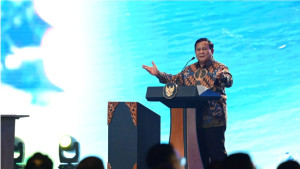
Prabowo launches over cooperatives to boost grassroots economic sovereignty
President Prabowo Subianto launched the institutional establishment of 80,081 Red-and-White Cooperatives (Koperasi Merah Putih) across the nation’s villages and urban neighborhoods, marking a major leap in Indonesia’s grassroots economic reform agenda.

Mt Rinjani trail closure sparks renewed call for safer, smarter mountain tourism
The authorities’ move to temporarily close a major hiking route on Mount Rinjani in Lombok, West Nusa Tenggara, following two back-to-back accidents involving foreign tourists has ignited broader discussion on mountain tourism safety, with experts emphasizing the urgent need for reform in high-risk ecotourism management.
House targets new oil and gas law in 2026, eyes major overhaul
The House of Representatives (DPR) will open the door to drafting a new Oil and Gas Law (UU Migas) in 2026 only upon the completion of deliberations on the New and Renewable Energy (EBT) Bill and the Electricity Bill, said Eddy Soeparno, Member of Commission VII and Deputy Speaker of the People’s Consultative Assembly (MPR).

Indonesia pushes for global palm oil standards to counter EU Deforestation Law
Deputy Foreign Minister Arif Havas Oegroseno has announced that Indonesia, in collaboration with relevant stakeholders, is preparing a global standard for palm oil management and trade, aimed at countering the European Union Deforestation Regulation (EUDR), which poses challenges for small-scale farmers in Indonesia − particularly those in palm oil, rubber, cocoa, and coffee sectors.