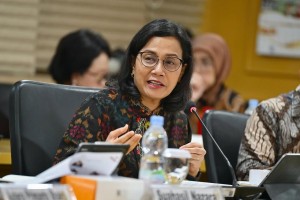



Minister of Finance Sri Mulyani Indrawati defended the government’s handling of the education budget amid criticism that its realization has consistently fallen short of the constitutionally mandated 20 percent of total state expenditure.
She emphasized that fluctuations in the realized education budget are largely a result of the dynamic nature of government spending components.
“Components such as capital expenditure, goods expenditure, subsidies, compensation, and interest payments are inherently fluid. Their absorption depends on real-time needs and economic conditions,” she told a hearing with Commission XI of the House of Representatives (DPR), which oversees finance and monetary policy, on Tuesday, July 22, 2025.
Her remarks came in response to strong criticism from Commission XI Deputy Chair Dolfie Othniel Frederic Palit, who questioned why the education budget had consistently failed to meet the 20 percent threshold since it was mandated in 2007.
Sri Mulyani noted that even though the budget framework sets education spending at 20 percent of total government expenditure, actual realization can vary.
She cited the example of additional social assistance during periods of climate crisis, such as El Niño, which increased spending in other sectors and skewed the apparent share of education spending.
“This does not mean the 20 percent is intentionally unmet,” she stressed.
”For instance, if capital expenditure absorption is low, the proportional 20 percent for education will also adjust downward. The same applies to goods expenditure, including travel and program-related costs,” Sri cited.
She said further that placing part of the education budget under the financing category such as the education endowment fund is a deliberate fiscal management strategy aimed at creating a cushion against future uncertainties.
“Not all allocated funds need to be spent immediately; quality and governance matter more than just quantity," she said.
To illustrate the rationale, Sri Mulyani remarked, “If we are forced to spend just to meet the 20 percent threshold, we might end up replacing school fences that aren’t even damaged.”
According to Dolfie, the education budget stood at 18 percent of total spending in 2007, dropping to 15.6 percent in 2008. More recent figures show minimal change: 15 percent in 2022, 16 percent in 2023, and 17 percent in 2024. For 2025, the allocation is again projected at 17 percent, with a portion placed in financing rather than direct spending.
Dolfie referenced the 2007 Constitutional Court ruling that affirmed the 20 percent requirement as a constitutional obligation not to be delayed. “Justice delayed is justice denied,” he said, quoting the ruling.
“That 20 percent must be fully accounted for in spending, including for teacher salaries. No more holding back funds under the pretext of reserves,” he added.
He asked the Finance Ministry to ensure that, going forward, the full 20 percent of the education budget be reflected in actual government spending, not in deferred reserves or financing structures.
Already have an account? Sign In
-
Start reading
Freemium
-
Monthly Subscription
20% OFF$29.75
$37.19/MonthCancel anytime
This offer is open to all new subscribers!
Subscribe now -
Yearly Subscription
33% OFF$228.13
$340.5/YearCancel anytime
This offer is open to all new subscribers!
Subscribe now
Set up email notifications for these topics