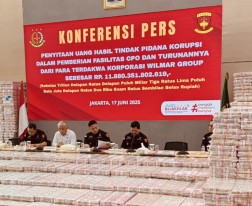



The Jakarta Corruption Court has sentenced three judges to 11 years in prison for their involvement in a bribery scheme connected to crude palm oil (CPO) export permits issued between January and April 2022, in a ruling that further exposes deep-rooted corruption within Indonesia’s judiciary.
Presiding Judge Efendi delivered the verdict on Wednesday evening, ordering Djuyamto, Agam Syarief Baharudin, and Ali Muhtarom to each serve 11 years and pay a Rp500 million fine (aboutUS$30,000), or face an additional six months’ imprisonment.
The court also imposed varying compensation orders, requiring the defendants, who are judges at the South Jakarta District Court, to repay illicit funds they received.
Under the ruling, Djuyamto must return Rp9.21 billion, while Agam and Ali were ordered to repay Rp6.4 billion each. Failure to pay will result in asset seizures and up to four additional years in prison.
In a related verdict, former Jakarta Utara court clerk Wahyu Gunawan was sentenced to 11 years and six months, along with a compensation payment of Rp2.36 billion, which also carries a substitute four-year prison term if unpaid.
The heaviest punishment was handed to former Deputy Chief Judge at the Central Jakarta District Court Arif Nuryanta, who received 12 years and six months in prison and a Rp500 million fine. Arif was also ordered to repay Rp14.73 billion.
Should he fail to settle the amount within one month after the verdict becomes final, prosecutors may seize and auction his assets. If his assets fall short, Arif will serve an additional five years in prison.
Although Arif was not part of the judicial panel handling the CPO export case, court findings showed he acted as a broker receiving bribes and distributing them among fellow judges. Prosecutors had earlier demanded 15 years for Arif, 12 years for Djuyamto, Agam, Ali, and Wahyu.
The court emphasized that the actions of the defendants severely tarnished the reputation of the judiciary. Judge Efendi said the offenders had ignored repeated warnings from Supreme Court leadership to uphold ethical conduct and preserve the integrity of the institution.
“These acts were committed not out of need, but out of greed corruption by greed,” Efendi said, noting that their positions as law enforcers made their crimes particularly egregious.
In granting leniency, the panel acknowledged that the defendants had returned part of the bribes and maintained family responsibilities.
The ruling adds to a growing list of corruption scandals implicating judges and court officials in Indonesia, highlighting the ongoing challenge of judicial reform and accountability.
Already have an account? Sign In
-
Start reading
Freemium
-
Monthly Subscription
20% OFF$29.75
$37.19/MonthCancel anytime
This offer is open to all new subscribers!
Subscribe now -
Yearly Subscription
33% OFF$228.13
$340.5/YearCancel anytime
This offer is open to all new subscribers!
Subscribe now
Set up email notifications for these topics