


The government has reaffirmed its commitment to achieving energy independence as a cornerstone of national sovereignty during the Abu Dhabi International Petroleum Exhibition and Conference (ADIPEC) 2025, signaling renewed determination to attract global investment and technology to strengthen its upstream oil and gas sector.
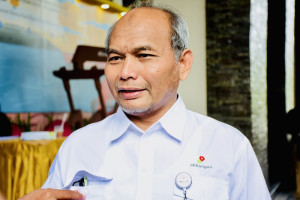
Head of the Upstream Oil and Gas Regulatory Task Force (SKK Migas) Djoko Siswanto said the government remains focused on ensuring that all international partnerships in the upstream energy sector generate tangible benefits for Indonesia’s long-term resilience.
“The Indonesian government is committed to ensuring that every international collaboration in the upstream oil and gas sector provides real value − strengthening energy security, developing local industries, and accelerating technology transfer,” Djoko said in Abu Dhabi on Monday, November 3, 2025.
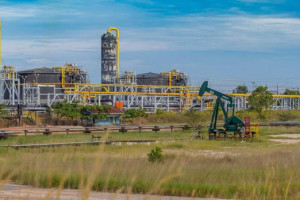
As outlined in the 2025–2029 National Medium-Term Development Plan (RPJMN), Indonesia aims to increase oil production by 31 percent and natural gas output by 51 percent by 2029. The targets are backed by fiscal and regulatory reforms intended to boost exploration and accelerate investment, particularly in frontier regions.
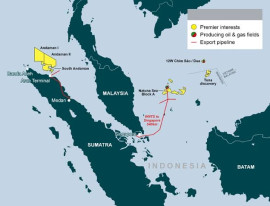
At ADIPEC 2025, Indonesia positioned itself as a strategic global partner offering mutually beneficial cooperation. The country is currently prioritizing investment in 14 potential basins, including South Sumatra Basin, estimated to hold 11.4 billion barrels of oil equivalent (BBOE) in gas reserves; Makassar Strait, with 29 BBOE of gas potential; and Warim Basin, with 25.9 BBO of oil and 42.2 trillion cubic feet (TCF) of gas.
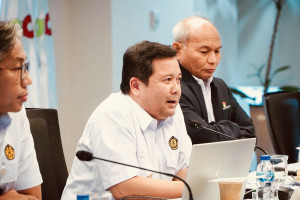
“Indonesia’s vast potential must be optimized through global partnerships that bring in technology and financing,” Special Staff to the Minister of Energy and Mineral Resources (ESDM) for Exploration and Production, Nanang Abdul Manaf, said.
“We already have a clear action plan to improve the investment climate, offering incentives, policy stability, and long-term direction for sustainable investment,” he added.
Nanang, who also served as Chairman of the Task Force for Upstream Production Acceleration, spoke during the opening of the Indonesia Pavilion, inaugurated by the Indonesian Embassy’s Chargé d’Affaires in Abu Dhabi.
Record investment momentum
The government views 2025 as a turning point for Indonesia’s upstream oil and gas sector. Investment realization in the first half of the year reached US$7.19 billion, with projections of up to US$15.9 billion by year-end − the highest in the past decade.
Djoko noted that policy reforms and licensing simplification had spurred global investor interest. Among the measures drawing attention are lower signature bonuses, a more flexible fiscal regime, streamlined block acquisitions, and enhanced data accessibility for exploration studies.
Currently, the government is offering nine working areas through direct offers, part of a broader five-year plan to open 75 new working areas to global investors.
Indonesia’s delegation to ADIPEC 2025 included representatives from SKK Migas, the ESDM Ministry, the Aceh Oil and Gas Management Agency (BPMA), eight oil contractors (KKKS), and five domestic companies (PDNs).
Participating KKKS companies included EMP (Energi Mega Persada), Eni Muara Bakau B.V, Harbour Energy, Husky-CNOOC Madura Limited, INPEX, Medco E&P Indonesia, Pertamina Hulu Energi, and TIS Energy.
The five local companies joining the delegation were CT Advance, PT Luas Birus Utama, PT Pertamina, PT Rainbow Tubulars Manufacture, and PT Teknologi Rekayasa Katub.
Their unified presence at the exhibition underscored Indonesia’s strategic intent to showcase its vast upstream potential and reinforce its position as a key energy player in the global market.
From resource to resilience
Held on November 3–6, 2025, ADIPEC brought together delegations from dozens of countries, including the United Arab Emirates, Saudi Arabia, the United States, and China.
For Indonesia, the event marked a defining step in its journey “from dependency to self-reliance” −transforming its natural resource wealth into a sustainable foundation for national energy security and global competitiveness.
“Our direction is clear: from resources to resilience, from dependence to independence,” Djoko said, emphasizing that the nation’s upstream transformation would be driven by collaboration, innovation, and transparency.
Already have an account? Sign In
-
Start reading
Freemium
-
Monthly Subscription
20% OFF$29.75
$37.19/MonthCancel anytime
This offer is open to all new subscribers!
Subscribe now -
Yearly Subscription
33% OFF$228.13
$340.5/YearCancel anytime
This offer is open to all new subscribers!
Subscribe now
Set up email notifications for these topics