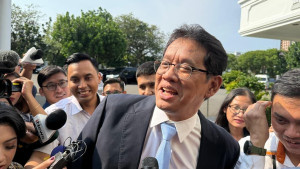



Eighteen regional heads visited Finance Minister Purbaya Yudhi Sadewa’s office in Jakarta on Monday, October 7, 2025 voicing protests over the government’s decision to reduce the 2026 regional transfer budget (TKD).
The meeting highlighted growing fiscal tensions between the central government and provincial leaders amid tightening national finances.
The Ministry of Finance and the House of Representatives’ Budget Committee (Banggar) recently agreed to increase next year’s TKD allocation by Rp43 trillion (US$2.6 billion), from Rp649.99 trillion to Rp692.99 trillion.
Despite the increase, the figure remains significantly lower than the 2025 allocation of Rp919 trillion, sparking concern among regional governments about their ability to fund routine expenses and infrastructure projects.
North Maluku Governor Sherly Tjoanda Laos said her province’s transfer funds would drop sharply from Rp10 trillion in 2025 to Rp6.7 trillion in 2026, with most of the reduction coming from Revenue Sharing Funds (DBH).
“From the Rp3.5 trillion cut, the biggest portion is from DBH, which makes up about 60 percent of our total transfers,” she said after the leaders’ meeting with Purbaya.
Sherly warned that reduced infrastructure spending would hamper road and bridge projects and urged the government to reconsider the cuts.
West Sumatra Governor Mahyeldi Ansharullah echoed similar concerns, noting that the decline in General Allocation Funds (DAU) and DBH would affect the provinces’ ability to pay wages of civil servants and contract-based employees (PPPK), as well as continue ongoing development projects.
“Our DAU is being reduced, while the central government is assigning more PPPK employees whose salaries must be paid by the regional government,” Mahyeldi said.
Jambi Governor Al Haris, who also chairs the Association of Indonesian Provincial Governments (APPSI), highlighted the struggle of regions with limited local revenue (PAD).
“For provinces with small PAD, this is very difficult. We hope the government will review and adjust the policy,” he said.
Responding to the protests, Purbaya said the government might reconsider additional funding based on state revenue performance and economic growth.
“If the economy improves, tax revenues rise, customs and taxation become more efficient − then of course we can share more,” he said.
Already have an account? Sign In
-
Start reading
Freemium
-
Monthly Subscription
20% OFF$29.75
$37.19/MonthCancel anytime
This offer is open to all new subscribers!
Subscribe now -
Yearly Subscription
33% OFF$228.13
$340.5/YearCancel anytime
This offer is open to all new subscribers!
Subscribe now
Set up email notifications for these topics