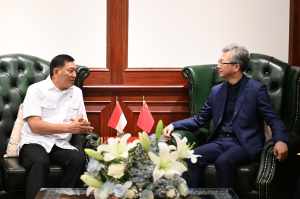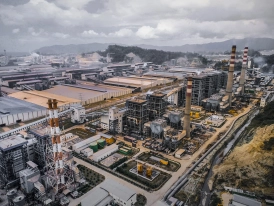



House of Representatives (DPR) legislators are demanding answers from the Minister of Transportation after the sudden public uproar surrounding the Indonesia Morowali Industrial Park (IMIP) airport, a privately built airstrip in Central Sulawesi whose operational status appears to be absent from formal discussions and parliamentary oversight.
The issue gained national attention after members of the public and even senior government officials questioned how the airport has operated for years without visible customs, immigration, or security presence.
Mori Hanafi, a NasDem Party lawmaker from the House’s Transportation Affairs Commission V, said the IMIP airport had never once been mentioned in hearings with the Transportation Ministry, raising questions about whether the facility’s licensing and operations were being monitored at all.
“We are genuinely surprised. Airport licensing lies with the Transport Ministry. But in all of our hearings, this airport was never brought up. Either it slipped through the cracks, or it was monitored but never reported to us. We simply do not know,” Mori told reporters at the House complex on Wednesday, November 26, 2025. Commission V is set to summon ministry officials for clarification in an upcoming hearing on December 2, 2025.
Mori, who also served on the special committee that drafted the newly passed Airspace Management Law, warned that any indication of international flights operating from IMIP would constitute serious violations involving immigration controls, customs supervision, and national security.
“How are passports stamped? How are the [incoming/ougoing] goods? If foreign nationals and cargo come in without customs or immigration, that is a violation of state authority,” he said.
“AirNav and the Directorate General of Civil Aviation must be aware and must supervise any flight operations there,” Mori added.
The controversy deepened after Defense Minister Sjafrie Sjamsoeddin expressed disbelief during a recent visit on November 19, noting that he did not see customs or immigration officers at the airport.
Public figures including Kurniawan, chairman of the Gerakan Cinta Prabowo (Love Prabowo Movement), also raised concerns that access to the airport was restricted and state presence appeared absent.
“This is strange. Where has the state been? I urge a thorough investigation. No selective enforcement,” Kurniawan said, adding that the airport has operated since being inaugurated by then president Joko Widodo in 2019.
Airport is legal
Lasarus, Chairman of Commission V, called for calm amid the public uproar. He said IMIP is categorized as a private-use airport which is regulated under Articles 247 to 252 of the 2009 Aviation Law.
“As long as it operates within the rules, it should be fine. We have not received indications of irregularities,” he said.
Under the law, private airports may be built by government entities, local authorities, or Indonesian legal entities, provided they secure ministerial approval, demonstrate land ownership, obtain local government recommendations, and meet environmental standards.
However, Article 249 explicitly prohibits private airports from serving international flights unless granted temporary, exceptional permission by the Transport Minister.
“We do not yet have data proving that international flights occurred. If they did, then that is a violation and the airport must be shut down,” Lasarus said.
He also responded to remarks suggesting IMIP functions like a “state within a state.” The commission, he said, will review whether such concerns reflect legal breaches or misunderstandings of how private airports operate.
Lasarus emphasized that even without on-site state officials, flight activity at any airport remains traceable. “Any aircraft planning to take off must request clearance. All of this is recorded by Air Traffic Control under AirNav Indonesia,” he said.
He noted examples of mission-operated airstrips in Papua, which operate similarly without full on-site government presence. “As long as there are no international flights, it is not inherently problematic,” he said. Security forces, he added, are free to enter the facility whenever needed.
The IMIP airport controversy underscores persistent tensions between Indonesia’s rapid industrial development and the state’s ability to maintain regulatory oversight especially in remote regions where private operators dominate.
Commission V’s upcoming hearing with the Transportation Ministry is expected to reveal whether IMIP has complied with national aviation law, whether it has ever served cross-border flights, and why its operations were never formally discussed at the parliamentary level.
Until then, lawmakers say the fundamental question remains unresolved: how a functioning airport inaugurated by a president could operate for years without the knowledge of the very agencies tasked to supervise it.
Already have an account? Sign In
-
Start reading
Freemium
-
Monthly Subscription
20% OFF$29.75
$37.19/MonthCancel anytime
This offer is open to all new subscribers!
Subscribe now -
Yearly Subscription
33% OFF$228.13
$340.5/YearCancel anytime
This offer is open to all new subscribers!
Subscribe now
Set up email notifications for these topics