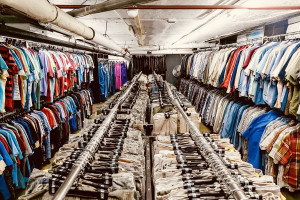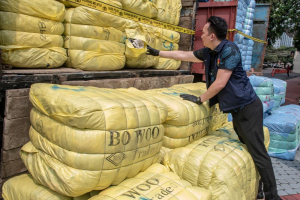



The Indonesian Confederation of Muslim Workers' Unions (Sarbumusi) has voiced its support for Finance Minister Purbaya Yudhi Sadewa’s plan to issue a regulation restricting widespread circulation of imported used clothing, calling it a necessary move to revive the struggling domestic textile industry.
Speaking on the sidelines of an International Labour Organization (ILO) event at the National Library in Jakarta on Wednesday, October 29, 2025, Sarbumusi president Irham Ali Saifuddin said the measure was “a strategic and long-overdue step” to protect local manufacturers.
“We highly appreciate Minister Purbaya’s initiative. This is a strategic step that must be taken. The national textile and garment industry has been sluggish, with waves of layoffs partly due to the flood of imported used clothes,” Irham said.
He urged the government to channel investment and implement a national reindustrialization program to revive labor-intensive sectors that have been in decline over recent years.
“Labor-intensive and manufacturing sectors have been collapsing. This is bad news and cannot be ignored. The state must make every strategic effort to revive national industries, including garments, textiles, and footwear,” he said.
Irham also noted that Purbaya’s planned regulation would not be sufficient on its own. He said broader enforcement against illegal imports is needed, emphasizing the roles of the Customs and Excise Directorate General and the Indonesian Quarantine Agency (Barantin).
“All illegal imports must be eradicated. The ball is now in the hands of Customs Office and Barantin. We have received reports of goods being cleared under inaccurate Harmonized System (HS) Codes. This must be rectified,” he said.
Irham also called on the Finance Minister to review other trade-related policies that he said have been undermining Indonesia’s textile competitiveness.
“Since his first day in office, Minister Purbaya has promised to deliver economic growth at above 7 percent. That goal is achievable only if labor-intensive industries are revived,” he said.
He added that the government must synchronize regulations across ministries, including those under the Trade Ministry, to curb the inflow of finished goods from abroad.
“If the government can stop the surge of imported garments, our domestic textile industry will thrive again, and we will remember Minister Purbaya as a ‘walk-the-talk’ leader who turns promises of 7 percent growth into reality,” he cited.
Background
The Finance Ministry’s upcoming ministerial regulation is part of a broader effort to curb the circulation of imported secondhand clothing, a trade that has grown significantly through online marketplaces and informal distributors.
The government argues that the practice not only harms domestic producers, but also poses hygiene and environmental risks.
Industry observers, however, say the success of such a policy will depend on enforcement at ports and stronger inter-agency coordination to prevent smuggling and misclassification of imported goods.
Already have an account? Sign In
-
Start reading
Freemium
-
Monthly Subscription
20% OFF$29.75
$37.19/MonthCancel anytime
This offer is open to all new subscribers!
Subscribe now -
Yearly Subscription
33% OFF$228.13
$340.5/YearCancel anytime
This offer is open to all new subscribers!
Subscribe now
Set up email notifications for these topics