


Indonesia Business Post
The Indonesia Confederation of Muslim Workers Unions (Sarbumusi) has called on the government to reform the governance system and improve the welfare of dock workers (TKBM), who remain among the most economically vulnerable in the country’s logistics sector.
Sarbumusi President Irham Ali Saifuddin said that dock workers across Indonesia’s ports continue to face poor working and social protection conditions. He stressed that the state must intervene to ensure their rights and welfare are upheld.
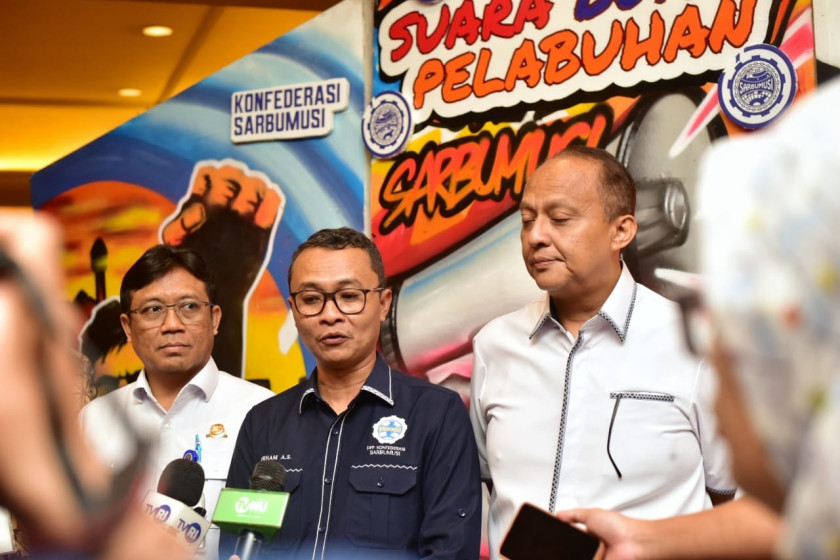
“These dock workers are at the very bottom of the economic pyramid in the logistics sector. We hope the government will prioritize their rights and welfare,” Irham said during the National Workshop on Optimizing TKBM Management Policy held at the Aryaduta Hotel, Jakarta, on Monday, October 13, 2025.
Irham said Sarbumusi has initiated meetings between government agencies, employers’ associations, and labor unions to find solutions to the issue.
He noted that the port sector contributes 7–8 percent to the national GDP each year, yet dock workers’ income and social protection remain far below that contribution.
“Many of our members report wages below the minimum standard, and even take-home pay lower than the regional minimum wage. Some are still not covered by social security,” Irham said.
Sarbumusi has previously proposed that the government subsidize at least 20 percent of BPJS Ketenagakerjaan (Employment Social Security) contributions for low-income workers to expand coverage for vulnerable labor groups such as dock workers.
Meanwhile, Director of Institutional Development and Labor Dispute Prevention at the Ministry of Manpower, Heru Widyanto, acknowledged that social protection for TKBM workers remains uneven.
“Around 42,000 dock workers are covered under BPJS Employment programs, including pension and old-age benefits. But with an estimated total of 86,000 workers, only half are protected,” Heru said.
To expand coverage, the ministry plans to collaborate with the Transportation and Cooperatives Ministries to conduct literacy and education programs for cooperatives and port employers to ensure compliance with social protection regulations.
Heru added that registered workers are also entitled to additional benefits such as home renovation assistance or access to mortgage loans (KPR) under BPJS programs.
Meanwhile, Deputy for Corporate and Institutional Participation at BPJS Ketenagakerjaan, Hendra Nopriansyah, said the workshop marks an important step toward consolidating policies among the government, employers, and TKBM cooperatives.
“We want to ensure that dock workers receive the welfare guaranteed by law. Port operators must enroll their workers in BPJS Employment and BPJS Health programs,” Hendra said.
Hendra noted that this effort aligns with the National Medium-Term Development Plan (RPJMN) target of achieving 99.5 percent worker coverage under national social protection programs. Currently, formal sector participation reaches around 55 percent, leaving significant room to expand coverage in the informal and vulnerable sectors such as dock work.
BPJS Ketenagakerjaan has disbursed Rp57 trillion (US$3.4 billion) in total benefits, including old-age savings, death benefits, and scholarships for workers’ children up to university level.
However, Hendra emphasized that incomplete worker data at the regional level remains a major challenge that requires stronger collaboration with the Transportation and Manpower Ministries.
From a legal standpoint, Masykur Isnan, a legal practitioner and chair of the Sarbumusi workshop committee, said that government efficiency measures such as the National Logistics Ecosystem (NLE) and Presidential Instruction No. 25/2020, must not only reduce logistics costs but also improve workers’ quality of life.
“Future industrial strategies cannot be separated from the ports and that includes container and dock workers,” Masykur said.
Irham added that worker development should be strengthened through training and internship programs for the children of dock workers, while labor interventions should focus on expanding social security, enforcing occupational safety standards, and ensuring fair labor contracts that cover minimum wages, leave, and severance pay.
“National logistics efficiency must go hand in hand with better welfare for its workers,” Irham concluded.
Already have an account? Sign In
-
Start reading
Freemium
-
Monthly Subscription
20% OFF$29.75
$37.19/MonthCancel anytime
This offer is open to all new subscribers!
Subscribe now -
Yearly Subscription
33% OFF$228.13
$340.5/YearCancel anytime
This offer is open to all new subscribers!
Subscribe now
Set up email notifications for these topics