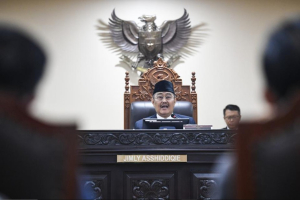



The Constitutional Court (MK) has partially granted a judicial review of Law No. 11/2021 amending Law No. 16/2004 on the Attorney General’s Office (or Prosecution Law).
The petition, Case No. 15/PUU-XXIII/2025, was filed by Agus Setiawan (activist/student), Sulaiman (lawyer), and the Perhimpunan Pemuda Madani (Madani Youth Association). The ruling was read out in a plenary session on Thursday, October 16, 2025.
The Court granted the petition of the first and second applicants in part, declaring Article 8(5) of the amended law unconstitutional and no longer legally binding, except when interpreted as providing exceptions in specific criminal circumstances.
The revised article now reads: “In carrying out their duties and authorities, the summoning, examination, search, arrest, and detention of prosecutors may only be conducted with the permission of the Attorney General, except in cases of: a. being caught in the act of committing a crime; or b. based on sufficient preliminary evidence of committing a criminal offense punishable by death, a crime against state security, or a special criminal offense.
The Court also struck down Article 35(1)(e) and its explanatory note, ruling both unconstitutional and without legal force.
Equality before the law
In his legal reasoning, Constitutional Justice Arsul Sani said that legal protection for law enforcement officers and public officials connected to the judicial power is important. However, such protection must not override the principle of equality before the law.
“Every citizen, including law enforcement officers, must remain subject to legal actions without special treatment,” Arsul emphasized. He added that protection should exist only within reasonable limits to safeguard judicial independence from interference or pressure.
Arsul explained that Article 8(5) could potentially create undue privilege for prosecutors, as it requires prior authorization from the Attorney General before any legal measures − such as summons, searches, or arrests − could be taken against them. “Therefore, the Court considers this provision conditionally unconstitutional,” he said.
The Court concluded that prosecutors suspected of criminal acts should not be immune from legal procedures, particularly in cases of flagrant offenses, serious crimes, or special criminal offenses.
Dissenting opinions
Two Constitutional Justices, Arief Hidayat and M. Guntur Hamzah, expressed dissenting opinions. They argued that Article 8(5) was intended as a protective mechanism, not as absolute immunity, ensuring that prosecutors could perform their duties without external intimidation.
They further contended that the Attorney General’s role as advocatus generalis − offering legal and technical considerations in the cassation process − enhances checks and balances when carried out professionally, transparently, and accountably.
The ruling marks a significant reaffirmation of the constitutional principle of equality before the law, curbing potential misuse of authority while maintaining necessary protections for prosecutors in performing their duties.
Already have an account? Sign In
-
Start reading
Freemium
-
Monthly Subscription
20% OFF$29.75
$37.19/MonthCancel anytime
This offer is open to all new subscribers!
Subscribe now -
Yearly Subscription
33% OFF$228.13
$340.5/YearCancel anytime
This offer is open to all new subscribers!
Subscribe now
Set up email notifications for these topics