


Indonesia’s long-standing ambition to strengthen its naval presence took a symbolic turn this week as the government under President Prabowo Subianto confirmed plans to acquire the Italian aircraft carrier ITS Giuseppe Garibaldi, marking what defense observers describe as a strategic leap in the nation’s maritime capability.
The initiative, endorsed by former Indonesian Navy Chief of Staff Admiral (ret) Marsetio, reflects Indonesia’s aspiration to project itself as a serious maritime power in the Indo-Pacific region, one that can secure not only its archipelagic waters but also its wider oceanic interests.
“A nation as vast as Indonesia should no longer be content with guarding its coasts and straits, it must be able to operate in the open seas,” Marsetio told Indonesia Business Post on Monday, October 13, 2025.
Marsetio, who served as Navy Chief of Staff from December 2012 until December 2014, recalled his experience leading the task force that took over East German naval vessels in the early 1990s. “A carrier is not just a ship, it is a symbol of technological mastery and strategic confidence,” he said.
The possible acquisition of Giuseppe Garibaldi, a light aircraft carrier previously in service with the Italian Navy, comes amid growing geopolitical competition in the Indo-Pacific, where sea lanes and strategic chokepoints have become arenas of global power rivalry.
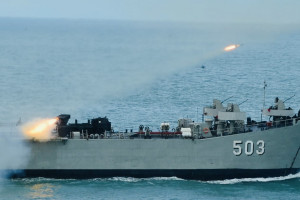
For Indonesia, which straddles the Indian and Pacific Oceans, the move signals a shift from a predominantly defensive maritime posture toward one emphasizing power projection and deterrence.
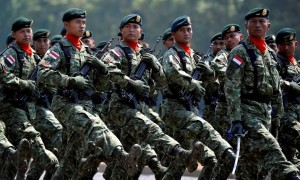
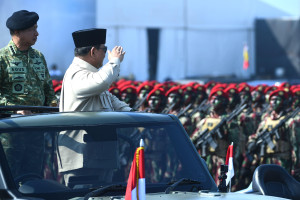
Defense analysts view the plan as consistent with President Prabowo’s long-term vision of modernizing the Indonesian Military (TNI), particularly the Navy, through greater self-reliance and a stronger industrial base.
While the idea of owning an aircraft carrier has stirred national pride, it has also triggered debate among defense experts and economists who question the project’s financial and operational feasibility.
Critics argue that Indonesia’s defense priorities should focus on strengthening its submarine fleet, maritime domain awareness, and coast guard capacity, given the country’s vast archipelagic geography and budget constraints.
However, Marsetio insists that strategic decisions cannot be measured purely in monetary terms.
“The aircraft carrier gives more than strike capability, it instills national confidence. President Prabowo is not merely buying a vessel; he is building a strategic consciousness for the nation,” he said.
Despite the symbolism, experts warn that technology alone will not guarantee success. The Navy’s ability to operate and maintain such a complex system depends heavily on human resources and education.
Marsetio emphasized that the challenge ahead lies in nurturing a new generation of naval officers capable of mastering advanced technologies while embodying discipline and leadership.
“Every ship has a soul, and every sailor believes that. We must cultivate human capital that matches our maritime ambition. Training must start early with a spirit of precision, teamwork, and resilience,” he cited.
An oceanic future
As Indonesia faces shifting geopolitical tides, its maritime strategy is expected to evolve in tandem with broader economic and diplomatic goals. The envisioned acquisition of Giuseppe Garibaldi if realized would mark a milestone in Indonesia’s transformation from a coastal defense nation to an outward-looking maritime actor.
Still, observers caution that symbolism must be matched by capability and planning.
In Marsetio’s words, “The sea is not only a strategic space where time, movement, and power intersect, it is the mirror of a nation’s soul. As long as we turn our backs on it, we will lose our direction,” he concluded.
Already have an account? Sign In
-
Start reading
Freemium
-
Monthly Subscription
20% OFF$29.75
$37.19/MonthCancel anytime
This offer is open to all new subscribers!
Subscribe now -
Yearly Subscription
33% OFF$228.13
$340.5/YearCancel anytime
This offer is open to all new subscribers!
Subscribe now
Set up email notifications for these topics