


Indonesia’s First Biennial Transparency Report (BTR) estimates that the country will require US$282 billion (Rp4,519 trillion) to support national climate actions through 2030that will cover both mitigation and adaptation efforts to meet the targets outlined in the country’s Nationally Determined Contribution (NDC).
Under Indonesia’s Enhanced NDC, greenhouse gas emissions reductions of 31.89 percent are expected to be achieved domestically, while 43.2 percent will be supported by international financing.
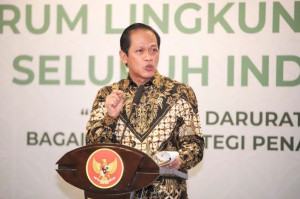
“The implementation of a multi-scheme carbon economic value is one of the key measures being developed to optimize climate financing,” Ary Sudijanto, Deputy for Climate Change Control and Carbon Economic Value Governance at the Ministry of Environment and Forestry, said as quoted in a statement on Thursday, October 9, 2025.
Of the total US$282 billion, US$281.18 billion is allocated for mitigation, while US$816.52 million is for adaptation initiatives. The energy sector requires the largest share of funding, totaling US$245.996 billion, followed by forestry and other land use (FOLU) at US$21.62 billion. Other sectors include waste management (US$13 billion), agriculture (US$504 million), and industrial processes and product use (IPPU) at US$65 million.
Indonesia has already secured several sources of climate finance, including US$103.8 million in Results-Based Payments (RBP) under the REDD+ program for FOLU from the Green Climate Fund (GCF), US$180 million from the Forest Carbon Partnership Facility (FCPF), and US$216 million in Results-Based Contributions from the Norwegian government.
The government is also strengthening bilateral cooperation with Japan and Norway to expand funding for the energy sector, including projects under the Clean Development Mechanism (CDM), currently implemented in 14 national energy projects.
“The Mutual Recognition Agreement (MRA) with five independent crediting schemes opens opportunities for carbon trading through 54 technology-based methodologies and 58 nature-based approaches,” Ary said.
This multi-scheme carbon trading system is expected to encourage private sector participation in adopting low-carbon technologies and improving efficiency, while also enabling community involvement through small-scale projects
Already have an account? Sign In
-
Start reading
Freemium
-
Monthly Subscription
20% OFF$29.75
$37.19/MonthCancel anytime
This offer is open to all new subscribers!
Subscribe now -
Yearly Subscription
33% OFF$228.13
$340.5/YearCancel anytime
This offer is open to all new subscribers!
Subscribe now
Set up email notifications for these topics