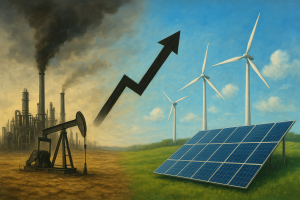



Indonesia must urgently accelerate its energy transition, as reliance on fossil fuels poses significantly greater public health risks and costs than previously anticipated, a recent report from the Global Climate and Health Alliance (GCHA) has concluded.
The report, titled "Cradle to Grave: The Health Toll of Fossil Fuels and the Imperative for a Just Transition," underscores that every stage of fossil fuel production, from extraction to waste disposal, leaves lasting health impacts on society; while pollution from coal, oil, and gas increases the risk of health problems such as premature births, miscarriages, childhood asthma, heart disease, cancer, and stroke in adults − with children and the elderly being the most vulnerable to these effects.
“Even with carbon capture technologies, fossil fuels will continue to poison, displace, and destabilize human life. Fossil fuels are not just a climate issue; they also drive a public health emergency,” Shweta Narayan, Campaign Chair at GCHA, said as quoted in a statement on Friday, October 3, 2025.
In many countries, including Indonesia, communities located near oil and gas operations, mining sites, and coal-fired power plants are directly affected. The report highlights a case of coal slurry spills in the Malinau River, North Kalimantan, in 2021, which polluted the environment and posed a health threat to local residents.
Moreover, microscopic particles (PM2.5) from emissions of sulfur, nitrogen oxides, and dust from coal-fired power plants can penetrate the lungs and bloodstream, leading to premature deaths and a range of health issues.
These incidents are not isolated; similar cases are widespread in Kalimantan, which is home to numerous coal mining operations. However, fossil fuel companies rarely bear the full costs of cleanup, remediation, and disaster recovery. As a result, these expenses are left to be absorbed by local communities.
Call for energy transition
The GCHA stresses the urgency of transitioning away from fossil fuels, particularly coal, to protect public health.
Wicaksono Gitawan, Program and Policy Manager at CERAH, said, “The government of Indonesia must prioritize energy transition from coal and other fossil fuels. There are many real-life examples showing how coal plants harm local communities. It’s time for the government to acknowledge that public safety should be its number one priority.”
Globally, fossil fuel subsidies reached $7 trillion in 2022. These subsidies, instead of alleviating public burdens, have been directed toward a sector that causes disease and premature death. Even as global financial institutions have committed to achieving net-zero emissions by 2050, they continue to fund the fossil fuel sector. For instance, JPMorgan Chase has financed the fossil fuel industry to the tune of $317 billion since the Paris Agreement.
Jeni Miller, Executive Director of GCHA, emphasized the need for an equitable energy transition, particularly for coal-producing nations like Indonesia.
“Policymakers worldwide must end the damage caused by fossil fuels by phasing out fossil fuel dependency and shifting to cleaner energy sources. This political courage should be expressed at COP30 in Belem, Brazil, in November,” Miller said.
Urgent action sought
The report stresses that a proper response to the fossil fuel crisis would involve governments halting new oil, gas, and coal projects and ending direct subsidies worth US$1.3 trillion to the fossil fuel sector. These resources should instead be invested in public health, clean energy, and supporting communities already burdened by pollution and climate damage.
“COP30 is a moment to act not just for the climate, but for public health and the future of societies,” Miller concluded.
The GCHA's report serves as a strong warning to Indonesia. If the government remains committed to its vision of becoming a leading economy by 2045, urgent steps must be taken to protect the health of the population, starting with reducing exposure to coal and fossil fuel pollution.
Already have an account? Sign In
-
Start reading
Freemium
-
Monthly Subscription
20% OFF$29.75
$37.19/MonthCancel anytime
This offer is open to all new subscribers!
Subscribe now -
Yearly Subscription
33% OFF$228.13
$340.5/YearCancel anytime
This offer is open to all new subscribers!
Subscribe now
Set up email notifications for these topics