


Indonesia and the European Union (EU) have signed the substantive conclusion of the Indonesia–European Union Comprehensive Economic Partnership Agreement (IEU–CEPA), marking a historic milestone in bilateral trade relations after nearly 10 years of talks.
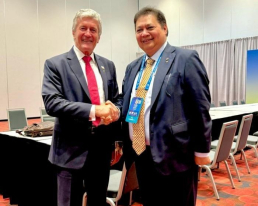
The signing ceremony in Bali on Tuesday, September 23, 2025, was attended by Indonesia’s Coordinating Minister for Economic Affairs Airlangga Hartarto and EU Executive Vice President for Trade and Economic Security Maroš Šefčovič.
European Commission President Ursula von der Leyen welcomed the deal, highlighting its strategic significance.
“Our deal with Indonesia creates new opportunities for businesses and farmers in a major and growing economy. This also provides us with a stable and predictable supply of critical raw materials, essential for Europe’s clean tech and steel industry,” she said on Tuesday, September 23, 2025.
Šefčovič echoed this, framing the agreement as a “new chapter” for EU–Indonesia relations.
“By gradually removing Indonesia’s 50 percent car import tariff, the agreement creates fresh opportunities for EU automotive exports and electric vehicle investments. In today’s unpredictable global economy, trade relationships are not merely economic tools – they are strategic assets that signal trust, alignment, and resilience,” he said, on Monday, September 24, 2025.
Talks began in July 2016 and involved 19 formal negotiation rounds plus intersessional meetings.
“After nine years of negotiations, under the leadership of President Prabowo Subianto, the IEU–CEPA has finally been concluded. This historic achievement underscores our commitment to fair, equitable, and sustainable cooperation,” Spokesman for the Coordinating Ministry for the Economy, Haryo Limanseto, said on Monday, September 22, 2025
Economic impact
The EU is Indonesia’s fifth-largest trading partner, with bilateral trade reaching US$30.1 billion (Rp502.4 billion) in 2024, up from US$27.6 billion in 2023. Indonesia recorded a trade surplus of US$4.5 billion with the EU in 2024, up from US$2.5 billion a year earlier.
Under the agreement:
● 80 percent of Indonesia’s exports to the EU will enjoy zero import tariffs, boosting labor-intensive industries such as footwear, textiles, garments, palm oil, fisheries, renewable energy, and electric vehicles;
● EU exporters will see duties removed on 98.5 percent of tariff lines, saving about €600 million (Rp11.8 trillion) annually;
● EU companies will gain full ownership rights in services like telecommunications and IT;
● Protections are introduced for intellectual property, geographical indications (221 EU and 72 Indonesian products), and safeguards for sensitive agri-food goods such as rice and sugar.
Agriculture Commissioner Christophe Hansen said the pact would significantly benefit EU farmers.
“Our producers will now enjoy preferential access to a market of 285 million consumers. As with every trade agreement, we have drawn clear red lines to safeguard our farmers — existing tariffs remain in place for rice and sugar, with calibrated quotas for sensitive products,” Hansen said on Tuesday, September 23, 2025.
Sustainability and raw materials
The CEPA incorporates a strong sustainability pillar, aligning with the Paris Agreement and prioritizing trade in renewable energy, low-carbon technologies, and green supply chains. It also ensures environmental and social safeguards in sensitive sectors such as palm oil.
Indonesia, as a leading producer of critical raw materials, will play a central role in supplying Europe’s green and digital transition, with commitments for sustainable and transparent supply chains.
Next steps
Following the signing, the draft texts will undergo legal review and translation into all official EU languages. The European Commission will then submit the deal to the EU Council for approval, before moving to the European Parliament and Indonesia’s ratification process.
If ratified smoothly, the agreement is expected to take effect on January 1, 2027.
“We want to see the benefits materialize quickly, particularly for Indonesia’s labor-intensive industries such as footwear, furniture, and textiles,” said Airlangga.
A win–win partnership
Industry leaders in both regions have welcomed the agreement as a game-changer, unlocking new export markets, strengthening supply chains, and reinforcing commitments to sustainability.
The IEU–CEPA stands as one of Indonesia’s most ambitious trade deals to date, cementing its role as a key economic partner in ASEAN and creating a free-trade zone of over 700 million consumers based on transparency, openness, and shared growth.
Already have an account? Sign In
-
Start reading
Freemium
-
Monthly Subscription
20% OFF$29.75
$37.19/MonthCancel anytime
This offer is open to all new subscribers!
Subscribe now -
Yearly Subscription
33% OFF$228.13
$340.5/YearCancel anytime
This offer is open to all new subscribers!
Subscribe now
Set up email notifications for these topics