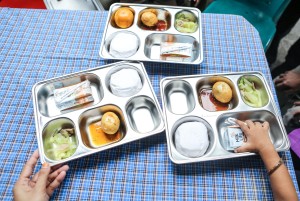



In the third week of August 2025, the Indonesia Business Post investigative team traveled to Chaoshan, an industrial hub in Guangdong Province, China. The area, home to 30–40 factories producing food trays for global markets, also supplies trays for a number of importers involved in Indonesia’s “Makan Bergizi Gratis” (MBG) or Free Nutritious Meal program for school children.
MBG, a flagship initiative of President Prabowo Subianto for the 2024–2029 period, is projected to reach 82.9 million students by the end of 2025 with a budget of Rp116.6 trillion (US$7.17 billion). Yet, beneath the program’s noble aim of improving child nutrition, IBP’s investigation uncovered serious potential scandals surrounding food tray procurement: illegal imports, violations of health standards, doubts over halal compliance, and indications of falsified labeling.
Fake “Made in Indonesia” labels and SNI

Our investigation revealed that several factories in Chaoshan are producing food trays marked “Made in Indonesia” and carrying SNI (Indonesian National Standard) certification, despite being manufactured in China.
SNI is the official national standard that guarantees a product meets Indonesian safety, quality, and performance requirements. Misusing it misleads consumers and undermines national regulatory oversight.
This scheme violates WTO rules and the Rules of Origin, and could be exploited to evade tariffs or import quotas, amounting to serious fraud and potentially masking illegal imports.
Under Indonesian law, parties involved may face criminal sanctions and fines under Law No. 7/2014 on Trade and Law No. 8/1999 on Consumer Protection.
Smuggled food trays and loopholes in regulations

In 2024, the Indonesian government, through Ministry of Trade Regulation No. 8/2024, banned imports of 10 commodities, including food trays. At the time, Coordinating Minister for Maritime and Investment Luhut Binsar Pandjaitan stressed the need to boost local production and reduce dependency on imports.
Yet on June 30, 2025, the Ministry of Trade officially repealed Permendag 8/2024, as part of a deregulation package covering the same 10 commodities. Coordinating Minister for the Economy Airlangga Hartarto cited that the repeal responded to global dynamics and aimed to enhance national competitiveness.
“Indonesia received a lower review this year. Deregulation is therefore essential as requested by the President to maintain competitiveness,” Airlangga told a press conference at the Ministry of Trade.
Ironically, the policy intended to strengthen local products did not restrict or prohibit imported food trays from other countries.
An anonymous industry source in Chaoshan said that in the first quarter (Q1) of 2024, before the ban was fully applied, approximately 1.2 million trays were shipped to Indonesia, valued at over US$2.4 million (around Rp40 billion).
Even after the ban took effect, millions of trays continued arriving between October 2024 and March 2025. One factory visited by IBP recorded orders of 3 million trays, worth US$6.1 million (Rp99 billion), just for its facility, not counting other factories that likely received similar orders.
An Indonesian business source revealed that 6–8 million trays still entered Indonesia during the active ban period (January–June 2025), either through disguised customs codes or outright smuggling.
IBP’s social media monitoring shows that during the transition between the repeal of Permendag 8/2024 (June 30, 2025) and the official reopening of import channels on August 30, 2025, dozens of containers of food trays were already delivered to MBG kitchens in Java and Lampung.
These findings suggest collusion between importers and officials, keeping import channels open despite regulations.
Demand and risks of foreign market domination
The National Nutrition Agency (BGN) reports that local producers can only manufacture 2 million food trays per month, far below the annual target of 82 million units. Yet, according to the Indonesian Food Tray Manufacturers Association (APMAKI) and the Association of Kitchenware and Cooking Equipment Producers (ASPRADAM), combined local production capacity could reach 11,492,900 units per month. This discrepancy raises questions about whether official figures understate local capabilities.
Despite sufficient local production potential, imports from China continue to surge. UN Comtrade and China Customs data show that stainless steel food trays (HS code 732391) shipped from China to Indonesia in 2024 reached US$25,084,493 (2,245,277 units), nearly double the 2023 figure of US$14,751,716 (1,458,265 units). The trend highlights a growing dependence on imports, signaling that market forces are favoring foreign suppliers over local capacity.
An Indonesian businessman explained that local manufacturers struggle to compete with Chinese trays, which are far cheaper. Factories in Guangdong’s Chaoshan region reportedly already received orders for around 40 million stainless steel trays destined for Indonesia this year, indicating massive import flows and a potential foreign market stronghold.
Indonesia Business Post is still awaiting official confirmation from the Ministry of Trade regarding import data, suspected falsified labels, and smuggling activities. Early findings show that significant volumes of food trays have entered Indonesia even during the import ban, raising pressing concerns about regulatory compliance, oversight, and the risks posed to programs like MBG. Clear, official clarification is urgently needed so that stakeholders, authorities, and the public can understand the true scale of imports and ensure children’s safety is protected.
Cheap trays, health risks, and weak oversight
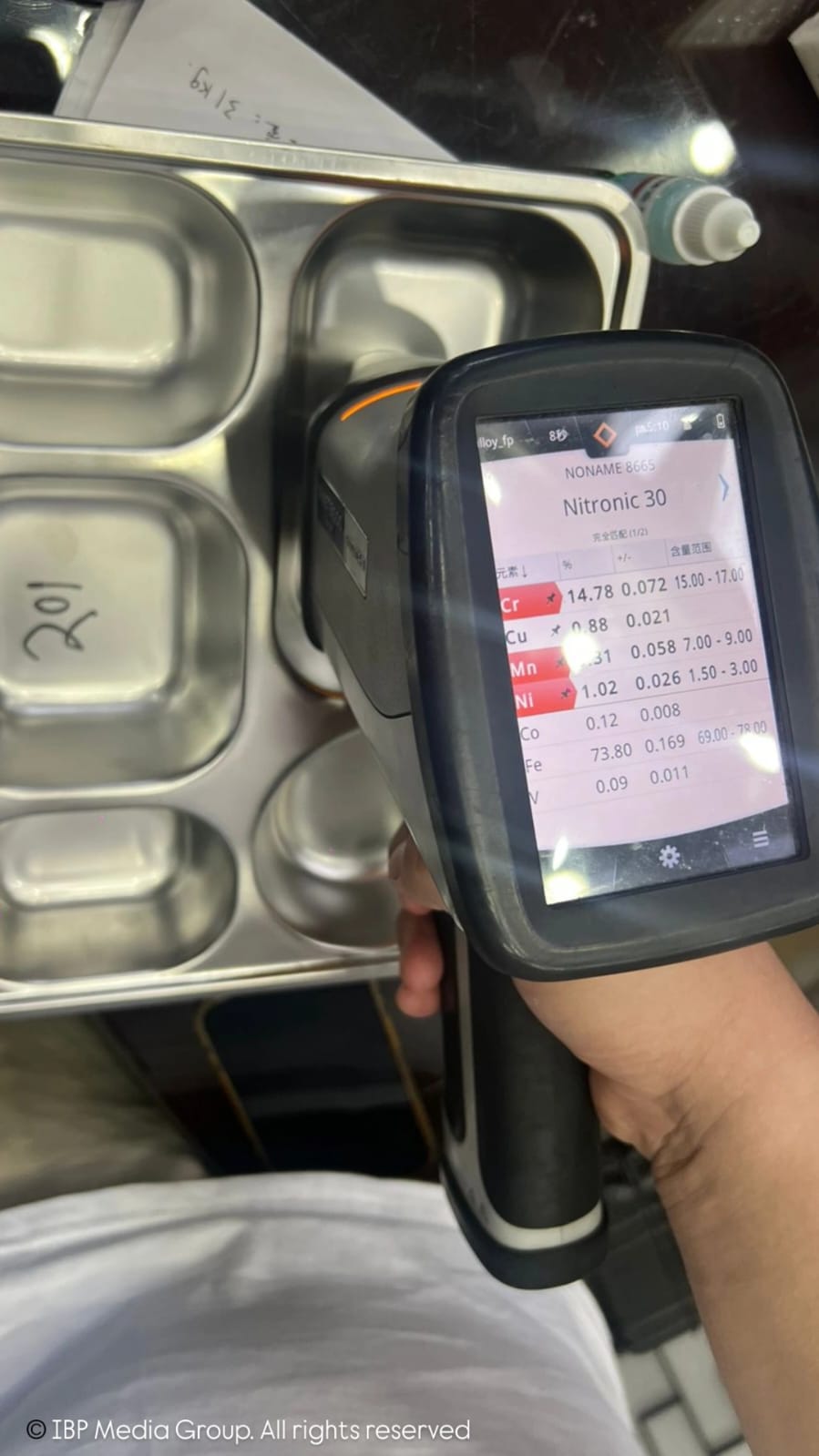
The stainless steel food trays used in the MBG program come in three types: premium, food-grade 316 and 304 trays, and non-food-grade 201 trays. The Indonesian government once imposed a ban on importing stainless steel 201 type to protect public health. However, our investigation found that this ban was poorly enforced, allowing a significant number of imported trays to circulate, potentially putting children at risk.
According to an importer based in Indonesia, the 201 type trays are still widely circulating, eventhough most importers order the 304 type. Market price pressures sometimes lead Chinese manufacturers to mix 304 type and 201 type trays, meaning millions of high-risk units are already in the hands of children. Of the national demand of 82 million trays, around 14 million units have entered the market, mostly imported from China, creating a clear and urgent threat to student health.
Local manufacturers in Chaoshan confirmed to our team that 201 type trays are banned for food use in China. They demonstrated how quickly 201 type trays rust when exposed to acidic liquids. Stainless steel 201 type contains high manganese (5.5–7.5percent) and nitrogen as a nickel substitute, making it cheaper but less resistant to high-salinity environments than 304 or 316 types.
Health experts and authorities stress that the 201 type stainless steel is not recommended for food contact as it more readily leaches metals, especially from acidic foods. The Indonesian Food and Drug Monitoring Agency (BPOM) testing in Central Java in March 2024 confirmed these risks: of 100 trays tested, 65 failed heavy metal tests, and most lacked QR codes or official certification. Prolonged or excessive manganese exposure can cause tremors, muscle stiffness, and damage to the lungs, liver, kidneys, and central nervous system. These findings underscore the urgent need for strict monitoring of food trays entering Indonesian classrooms.
The 304 type trays, which meet the SNI, are safe to use and can be produced in both Indonesia and China, but they can cost up to 40 percent more than the 201 type trays. An APMAKI business member said: “Importers prefer 304 type, but want 201 type prices, so Chinese manufacturers may include 201 type or a mix of 201 and 304 types to lower costs and win the market. But 201 type is risky, especially for school children.”
Lubricants suspected of lard content in MBG trays

Indonesia Business Post investigations at several factories in Chaoshan, China, uncovered indicators suggesting that the production of food trays, both 201 and 304 types, might involve the use of lard oil as part of industrial lubricants. According to factory documents and interviews, lard oil is sometimes mixed with mineral oils and other additives to reduce friction and improve machinery performance during stainless steel fabrication, especially in heavy-duty operations.
One Safety Data Sheet (SDS) obtained by IBP hints at the possible use of lard oil, prompting further scrutiny because the lubricant comes into direct contact with stainless steel intended for children’s food trays. If confirmed, this could raise serious questions about halal compliance for the MBG school meal food trays.


Our team is currently monitoring the development of laboratory tests in two facilities in the Jakarta and surrounding area, which aim to determine chemical composition and verify whether animal-derived substances are present. We are also following updates on examinations of food trays from multiple SPPG (Nutrition Fulfillment Service Unit) sources to confirm whether circulating products are truly 304 type stainless steel or non-food-grade 201 type.
Indonesia’s two largest Islamic organizations, Nahdlatul Ulama (NU) and Muhammadiyah, have not yet provided statements regarding the halal status of imported food trays from China. An official from Nahdlatul Ulama Students’ Association (IPNU) emphasized that determining halal certification is a complex, multi-step process, highlighting the crucial role of laboratory results in clarifying whether these trays meet religious and safety standards.
Importers’ Response
When asked about the entry of food trays during the period when the import ban was still in effect, one Indonesian importer explained that their goal was simply to conduct trade and business. They stressed that any questions regarding legality, permits, or clearance should be directed to Indonesian Customs, as the authority responsible for regulating imports at the border.
For safety reasons, Indonesia Business Post has chosen to withhold the importer’s identity.
Roles of BGN and Ministry of Industry
Technical implementation of the MBG program on the ground relies heavily on foundation-run school kitchens, which purchase supplies, including food trays, independently. Nevertheless, the National Nutrition Agency (BGN), as the primary fund holder and supervisory body, has the responsibility to ensure that these kitchens do not purchase smuggled, substandard, or unverified halal products.
Interviews conducted by Indonesia Business Post with BGN Head Dadan Hindayana revealed that he does not consider himself authorized to oversee the quality of imported food trays used by the MBG kitchens. He only said that he would follow recommendations from “the relevant authorities.”
“BGN is only user of the food trays. There must be an authorized institution to give an assessment on them,” Dadan said in a text message to Indonesia Business Post, without specifying the institution.
Responding to IBP’s findings regarding Chinese-imported trays labeled “Made in Indonesia” and SNI, Director General of Metal, Machinery, Transportation Equipment and Electronics Industry (ILMATE) at the Ministry of Industry, Setia Diarta, emphasized that indications of violations must first be traced through the production origin system and verified by the agency issuing the SNI label. He added, “If violations are confirmed, we fully support legal action in accordance with applicable laws and regulations.”
National Standardization Agency (BSN) and Suspected Label Fraud
The use of “Made in Indonesia” labels on products actually manufactured or assembled in China violates international trade law, including WTO Rules of Origin and anti-misleading labeling provisions in various trade agreements. Origin labeling is not merely a commercial attribute but a legal instrument defining tariff rights, market access, and product safety standards. Misrepresenting the origin constitutes fraudulent mislabeling, potentially resulting in administrative sanctions, product recalls, trade fines, and even international litigation from affected trading partners.
When asked about IBP’s findings of Chinese trays labeled “Made in Indonesia” and SNI, Budi Triswanto, Head of Data and Communication Systems at the Natinal Standardization Agency (BSN), did not provide a direct response. He suggested inquiries be directed to BSN’s Public Relations office. This stance indicates that the agency tasked with issuing and supervising SNI labels has yet to provide clear public clarification, leaving room for potential misuse of Indonesia’s national standards on imported products.
Ministry of Trade and import regulatory gaps
IBP’s investigation into imported food trays entering Indonesia reveals serious gaps in import regulatory oversight. Although Ministerial Regulation No. 8/2024 temporarily banned the import of cheap stainless steel 201 type trays, field practices show that products still entered through official channels or disguised under different HS codes, even before the regulation was officially repealed.
As the body governing import flows, the Ministry of Trade plays a central role in preventing substandard or hazardous products from entering the market. Yet official confirmation regarding import volumes, suspected label fraud, and smuggling mechanisms is still pending. This raises pressing questions about regulatory compliance and effective oversight.
Alarmingly, the repeal of Permendag 8/2024 has created an opening for importers to expand the flow of cheap Chinese trays without clear limits, while risky products with unverified safety and halal status are already circulating. These findings underscore the urgent need for rapid, transparent action from the Ministry of Trade, including import audits, stringent tracing systems, and enforcement against violations, to protect children as the end users.
MBG at the crossroads
IBP is currently awaiting Safety Data Sheets (SDS/MSDS) from factories regarding lubricants used in stainless steel food tray production for imports. Initial investigations indicate possible use of lard oil or derivatives as a component of lubricants. If confirmed, this could raise serious issues, not only regarding food safety but also compliance with halal standards and international trade regulations. Transparency in SDS/MSDS disclosure is therefore critical for the public and stakeholders to understand production processes and chemical usage.
The MBG program is a large-scale initiative with a noble goal: improving the nutrition of Indonesia’s children. Yet if its implementation is undermined by illegal imports, hazardous goods, and potentially non-halal eating utensils, not only are children’s health at risk, but public trust in government reaches a critical juncture.
Indonesia Business Post continues to await laboratory results to strengthen this report. We also await official responses from the Ministry of Trade, BPOM, Halal Product Assurance Organizing Agency (BPJPH), Health and Social Security Affairs Commission IX of the House of Representatives, and further discussions with the Ministry of Industry, BSN, and BGN. What is at stake is not merely the Rp116.6 trillion budget allocated for MBG through the end of 2025, but ensuring the program is implemented safely and in compliance with health, safety, and halal standards, so that children receive meals that meet established protections.
Already have an account? Sign In
-
Start reading
Freemium
-
Monthly Subscription
20% OFF$29.75
$37.19/MonthCancel anytime
This offer is open to all new subscribers!
Subscribe now -
Yearly Subscription
33% OFF$228.13
$340.5/YearCancel anytime
This offer is open to all new subscribers!
Subscribe now
Set up email notifications for these topics