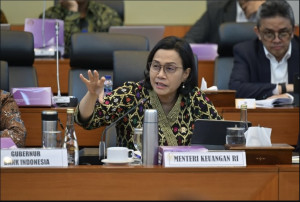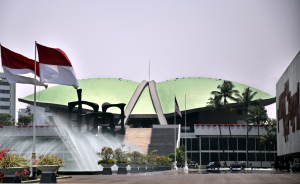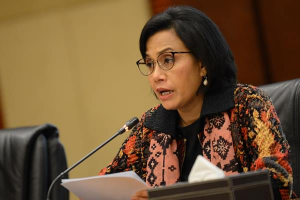



The House of Representatives (DPR) on Tuesday, Sept. 23, 2025, approved the 2026 State Budget (APBN) bill into law during its fifth plenary session of the 2025–2026 sitting period.
Chair of the House Budget Committee (Banggar), Said Abdullah, said the 2026 budget was designed to act as a fiscal weapon and a safeguard against economic turbulence, especially for poor and vulnerable households.
“The 2026 State Budget is positioned as an instrument of social protection, while also driving the recovery of small and medium enterprises, logistics chains, transportation, tourism, and creative industries,” Said Abdullah said in his speech.
The 2026 fiscal plan marks the second state budget under President Prabowo Subianto’s administration. Said Abdullah noted it was crafted to lay the foundation for industrial revival, particularly in basic sectors such as textiles, agriculture, and energy.
Under the approved budget, macroeconomic assumptions include:
- Economic growth: 5.4 percent
- Inflation: 2.5 percent
- Exchange rate: Rp 16,500 per US dollar
- 10-year government bond yield: 6.9 percent
- Indonesian crude price (ICP): US$70 per barrel
- Oil lifting: 610,000 barrels per day
- Gas lifting: 984,000 barrels of oil equivalent per day
Development targets
The budget sets ambitious targets, including reducing the open unemployment rate to 4.44–4.96 percent, cutting poverty to 6.5–7.5 percent, and bringing extreme poverty down to between 0 and 0.5 percent. The Gini ratio is targeted at 0.377–0.380, while the Human Capital Index is projected at 0.57 and the Farmers’ Welfare Index at 0.7731.
Other targets include creating 37.95 million formal jobs, raising gross national income (GNI) per capita to US$5,520, and reducing greenhouse gas emission intensity by 37.14 percent.
The government set state revenue at Rp3,153.58 trillion, comprising tax revenue of Rp2,693.71 trillion, non-tax revenue of Rp459.2 trillion, and grants of Rp660 billion.
State expenditure is set at Rp3,842.73 trillion, allocated to ministries/agencies (Rp1,510.55 trillion), non-ministerial spending (Rp 1,639.19 trillion), and transfers to regions (Rp 692.99 trillion).
To cover the gap, the government allocated Rp689.15 trillion in financing. The 2026 fiscal deficit is projected at Rp689.15 trillion, or 2.68 percent of gross domestic product (GDP), with a primary balance deficit of Rp89.71 trillion.
Already have an account? Sign In
-
Start reading
Freemium
-
Monthly Subscription
20% OFF$29.75
$37.19/MonthCancel anytime
This offer is open to all new subscribers!
Subscribe now -
Yearly Subscription
33% OFF$228.13
$340.5/YearCancel anytime
This offer is open to all new subscribers!
Subscribe now
Set up email notifications for these topics