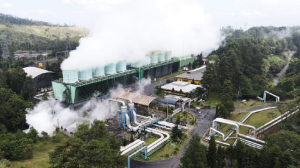



Civil Society Coalition staged a protest on Wednesday, September 17, 2025, against the 11th Indonesia International Geothermal Convention and Exhibition (IIGCE) held at the Jakarta Convention Center as a response to the government’s relentless push to develop geothermal energy sources, which they accused of bringing disaster to communities and the environment.
Coalition members involved were the Mining Advocacy Network (Jatam), the Terranusa Indonesia Institute, the Youth Union of East Nusa Tenggara (SP-NTT), and the Indigenous Land Advocacy Network (JAGAD).
During the protest, several affected community members from various geothermal project sites were physically assaulted.
“They were pushed, beaten, and forcibly dragged out of the meeting space while attempting to expose facts that have long been ignored or even concealed by the government,” Alfarhat Kasman, a Jatam campaigner, said in a statement on Thursday, September 18, 2025.
“This behavior demonstrates that the State is not only turning a deaf ear to the voices of the people, but also actively suppressing truths that do not align with the energy transition narrative they are constructing,” he added.
The Ministry of Energy and Mineral Resources (ESDM) has set up 356 geothermal prospects along Indonesia’s volcanic ring, which are highly prone to disaster risks. As of September 2025, 63 land areas in Indonesia have been designated as Geothermal Work Areas (WKP), encompassing 3,570,769 hectares, with most of these areas being forested.
Communities from Poco Leok, Mataloko, Manggarai Regency, East Nusa Tengara, and other geothermal mining regions are attending the three-day conference to convey that the geothermal mining industry is not a solution to climate change. The exploitation of landscapes and water, the destruction of air and water quality poisoning human bodies, and the forcible occupation of people’s living spaces are clear evidence that the geothermal mining industry is a dirty industry.
Land grabbing
Alfarhat said further that the seizure of forests and lands belonging to indigenous communities for extractive projects across the archipelago also robs the communities of their sovereignty. This land grabbing cannot merely be seen as a land acquisition, it is the destruction of life systems that have been built collectively and across generations.
He cited that indigenous communities that have long protected forests, water springs, and sacred sites are forced to give up their living spaces through non-transparent and manipulative licensing schemes.
“When indigenous lands are seized, their sovereignty is stripped − they lose their right to determine their way of life, values, and policies that align with local principles. The State, instead of being a protector, facilitates and even becomes an actor in this land grabbing by legalizing projects through regulations that disregard meaningful participation,” he said.
“In this context, the forced presence of geothermal projects can be seen as a new form of colonialism that erases identities, destroys ecological relations, and marginalizes communities from their own history,” he added.
These destructive impacts are evident in various geothermal mining operations. In Sorik Marapi, Mandailing Natal, North Sumatra, apart from threatening water sources, rice fields, and residential areas, the operations of PT Sorik Marapi Geothermal Power (SMGP) have led to eight deaths and poisoned 350 others exposed to H2S gas. In Dieng, Central Java, PT Geo Dipa's operations have killed two people, and dozens more have been poisoned by repeated H2S gas leaks.
In Pengalengan, West Java, geothermal extraction operations for the Wayang Windu Geothermal Power Plant managed by PT Stars Energy led to the loss of an entire Cibitung village. The incident on May 5, 2015, left more than 200 villagers traumatized, with six deaths, three missing, and several injured. Heavy rains triggered a landslide that caused geothermal pipe to explode.
Despite repeated leaks, there has been no serious evaluation of geothermal projects in disaster-prone areas, revealing the government’s prioritization of financial profits over the lives and safety of citizens.
In Mataloko, PT PLN Geothermal’s operations frequently release mud bursts on villagers’ farmland, spreading over a radius of 2,000 m². The sulfur smell dominates the air, and every morning, residents are forced to inhale sulfur with every breath. The hot mud also floods rice fields, contaminates water, causes skin diseases, and sinks land around settlements.
Amid aggressive promotion of geothermal energy as renewable energy source, Indonesians must be aware that geothermal exploration and extraction for electricity generation carry serious risks. Various geothermal mining projects have repeatedly triggered induced earthquakes, which the government continues to deny, while international scientists have proven the correlation between geothermal extraction activities and earthquakes, whose findings have been published in numerous scientific journals as references.
Jatam has repeatedly warned about the correlation between geothermal extraction activities and induced earthquakes, but to no avail.
To this day, no scientific investigation on the alleged link between geothermal activities and earthquakes − such as the 2022 Cianjur earthquake − has been conducted seriously. This neglect demonstrates the government’s disregard for the potential dangers posed by geothermal extraction activities that threaten citizens’ safety, Alfarhat said.
Policy manipulation
Alfarhat alleged that to pave the way for geothermal projects, the government has resorted to deceitful tactics, including manipulating regulations. This is evident in the legalization of geothermal mining in conservation forest areas by removing geothermal energy from the category of mining. This move traces back to the 2014 Geothermal Law (Law No. 21/2014), which repealed the 2003 Geothermal Law (Law No. 27/2003).
More recently, the government emphasized geothermal activities as environmental services with the passing of the 2024 Law on Conservation of Natural Resources and Ecosystems, which was issued in December 2024. In other words, the government aims to treat geothermal extraction as an environmental service activity, akin to ecotourism in conservation forests.
These regulations fundamentally ignore the extraction process of geothermal energy as mining activity. The production of geothermal energy involves the exploration, exploitation, and extraction of geothermal fluids to be used for electricity generation or other non-electric applications. Therefore, geothermal extraction is analogous to any other mining project.
Communities resisting geothermal exploration are labeled as anti-development, criminalized, and subjected to intimidation by state apparatus that protects corporations rather than the people. This violence is not an isolated incident, but part of a systematic pattern that secures business interests while silencing citizens’ constitutional rights to speak out, protect their ancestral lands, and reject ecological destruction disguised as progress.
Already have an account? Sign In
-
Start reading
Freemium
-
Monthly Subscription
20% OFF$29.75
$37.19/MonthCancel anytime
This offer is open to all new subscribers!
Subscribe now -
Yearly Subscription
33% OFF$228.13
$340.5/YearCancel anytime
This offer is open to all new subscribers!
Subscribe now
Set up email notifications for these topics