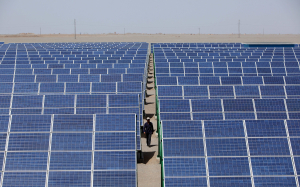



The Institute for Essential Services Reform (IESR) has urged the Indonesian government to provide stronger incentives for the domestic solar module industry, particularly through the exemption of import duties on raw materials for solar power plants (PLTS).
Alvin Putra, IESR’s Electricity and Renewable Energy Analyst, said that while tax incentives are currently available for companies investing in industrial or special economic zones, they do not cover import duty exemptions for essential raw materials.
“In fact, 50 to 60 percent of the total production cost of solar modules comes from importing raw materials,” Alvin said as quoted by Antara on Tuesday, September 2, 2025.
He cited that local solar modules are still 30–40 percent more expensive than imported products, limiting domestic demand. Despite Indonesia’s installed production capacity of 11.7 GWp per year, absorption remains low.
Alvin argued that eliminating import duties would help reduce the price gap and spur growth in local demand, particularly if the government ensures steady utility-scale solar projects.
“The government needs to prepare a strategy so that local content requirements (TKDN) remain attractive for investment while protecting local industry,” he added.
Alvin also highlighted that although solar cell factories exist in Indonesia, most production is still geared toward exports due to higher international prices, leaving the domestic solar cell market underdeveloped.
Marlistya Citraningrum, IESR’s Sustainable Energy Access Program Manager, said solar power adoption in Indonesia is progressing across different scales − from rural electrification to industrial and utility-scale projects.
However, the industry continues to face recurring challenges such as inconsistent regulations, limited financing schemes, and a weak domestic supply chain.
She noted that momentum for solar energy has grown in the past five years, especially since the government introduced rooftop solar regulations in 2018, driving rapid adoption in the industrial sector. By May 2025, Indonesia’s total installed solar power capacity surpassed 1,000 MW for the first time.
Meanwhile, Andriah Feby Misna, Director of Various New and Renewable Energy at the Ministry of Energy and Mineral Resources (ESDM), said the government is currently revising regulatory frameworks to support renewable energy development. This includes an amendment to Presidential Regulation No. 112/2022 and ministerial regulations on grid-connected solar power.
She emphasized the importance of regional government involvement, such as aligning spatial planning with solar investments, mediating land acquisition issues, allocating regional budgets for public solar projects, and offering additional incentives for renewable energy development.
Already have an account? Sign In
-
Start reading
Freemium
-
Monthly Subscription
20% OFF$29.75
$37.19/MonthCancel anytime
This offer is open to all new subscribers!
Subscribe now -
Yearly Subscription
33% OFF$228.13
$340.5/YearCancel anytime
This offer is open to all new subscribers!
Subscribe now
Set up email notifications for these topics