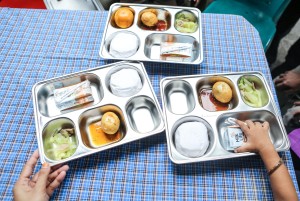



Trade Minister Budi Santoso said food tray imports could be suspended if inspections confirm the use of pork-based oil in their production, a statement msde amid controversy surrounding stainless steel trays used in the government’s Free Nutrition Meals (MBG) school program.
The Food and Drug Monitoring Agency (BPOM) is currently conducting laboratory tests on the trays to verify contamination allegations.
“We are still waiting for the inspection results, one of them from BPOM, to confirm whether it is true or not,” Budi told reporters after attending the IFRA Business Expo 2025 at Jakarta International Convention Center on Friday, August 29, 2025.
“If it is proven that the trays contain pork fat, then we will stop imports from the supplier concerned, particularly if the factory uses pork oil in production,” he added.
Asked whether the potential ban could involve imports from China, Budi acknowledged the possibility but emphasized that any decision must be based on formal investigation. “Yes, for example if it is from China, we will first verify which supplier is involved,” he said.
Alternatives
As a precautionary measure, Budi said the government is considering alternative suppliers that can guarantee halal-compliant production processes.
“We will look for suppliers whose products do not contain pork oil. That is one of the solutions,” he noted.
The minister also revealed that the Trade Ministry has proposed mandatory Indonesian National Standard (SNI) certification for all food trays, whether imported or domestically manufactured.
“We are pushing for food trays to be subject to mandatory SNI requirements. There are many technical standards that need to be fulfilled to ensure safety and quality, and SNI is the right mechanism,” Budi said.
“We have already discussed this with relevant ministries,” he added.
Investigative findings from China
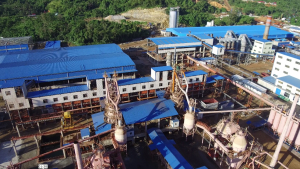
An Indonesia Business Post investigation into several factories in Chaoshan, China a hub for stainless steel manufacturing found indications that both type 201 and type 304 food trays may involve the use of lard oil as part of industrial lubricants.
Factory documents and interviews suggested that lard oil is sometimes blended with mineral oils and additives to reduce friction during heavy-duty stainless steel fabrication.
One Safety Data Sheet (SDS) reviewed by IBP hinted at lard oil use in production processes, raising red flags since the lubricants come into direct contact with stainless steel later shaped into food trays for children.
If verified, the practice could pose serious implications for halal compliance, particularly given the MBG program’s scale and its target beneficiaries millions of Indonesian schoolchildren.
Already have an account? Sign In
-
Start reading
Freemium
-
Monthly Subscription
20% OFF$29.75
$37.19/MonthCancel anytime
This offer is open to all new subscribers!
Subscribe now -
Yearly Subscription
33% OFF$228.13
$340.5/YearCancel anytime
This offer is open to all new subscribers!
Subscribe now
Set up email notifications for these topics