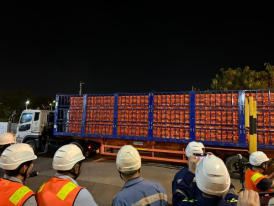



The Ministry of Trade has proposed the introduction of an Indonesian National Standard (SNI) for all food trays, both imported and domestically produced, following reports that some trays used in the government’s Free Nutritious Meals (MBG) program may contain pork fat.
Trade Minister Budi Santoso said the move was discussed in an inter-ministerial meeting to ensure that food trays circulating in the market comply with national safety and quality benchmarks.
“We have proposed that food trays be required to use SNI. If there are doubts about the product, the fact that it has SNI certification will provide assurance,” Budi spoke to Indonesia Business Post in Jakarta on Thursday, Aug 28, 2025.
He stressed that the alleged contamination of imported food trays has no relation to the government’s deregulation policy that recently relaxed import requirements.
“At this point, it has not been proven that the trays contain pork fat. That requires laboratory testing. If it turns out to be true, then we will simply switch to another supplier. But this has nothing to do with the trade regulation changes,” Budi said.
The minister cited that the decision to open food tray imports was made to meet surging demand for the MBG program. Domestic manufacturers currently produce around 15 million trays annually, far below the 80 million units needed, leaving a large supply gap that must be filled through imports.
“Food trays have always been allowed for import. Previously, importers needed technical considerations and recommendations, but after deregulation, those requirements were lifted. Domestic producers can still compete, but the gap is too large to be met locally,” he added.
Earlier, the National Standardization Agency (BSN) issued SNI 9369:2025 on stainless steel sectioned trays for food, specifically to support the MBG program.
The government’s latest deregulation package relaxed import requirements on 10 commodities, including forestry products, subsidized fertilizers, plastic raw materials, alternative fuels, saccharin, cyclamate, alcohol-based fragrance preparations, certain chemicals, pearls, food trays, footwear, and bicycles.
Previously, the government, through Ministry of Trade Regulation No. 8/2024, banned imports of 10 commodities, including food trays. At the time, Coordinating Minister for Maritime and Investment Luhut Binsar Pandjaitan stressed the need to boost local production and reduce dependency on imports.
Yet on June 30, 2025, the Ministry of Trade officially repealed Permendag 8/2024, as part of a deregulation package covering the same 10 commodities. Coordinating Minister for the Economy Airlangga Hartarto cited that the repeal responded to global dynamics and aimed to enhance national competitiveness.
Already have an account? Sign In
-
Start reading
Freemium
-
Monthly Subscription
20% OFF$29.75
$37.19/MonthCancel anytime
This offer is open to all new subscribers!
Subscribe now -
Yearly Subscription
33% OFF$228.13
$340.5/YearCancel anytime
This offer is open to all new subscribers!
Subscribe now
Set up email notifications for these topics