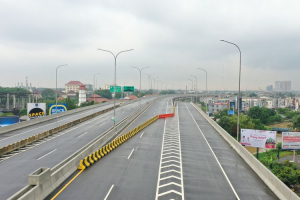



Secretary General of the Indonesian Toll Road Association (ATI), Krist Ade Sudiyono, said that, to date, there have been no formal discussions between toll road operators (BUJT), the project executors of the Multi-Lane Free Flow (MLFF) system, and the government regarding business model for toll collection under the system.
Currently, only a conceptual MLFF system model has been legally developed between the government and its partner, Roatex. ATI has yet to express agreement or disagreement with the model agreed upon by the government and Roatex.
"Thus far, discussions have been informal; we've submitted some suggestions and inputs. We are still awaiting responses, and the current focus is on the government testing the system's reliability. We have not yet reached the commercial phase. Our discussions are more about whether the technology is suitable," Sudiyono said on Tuesday, August 12,2025.
He emphasized that, like all public infrastructure, toll road operations fall under the domain of the government. “It is the government's responsibility to provide public infrastructure. However, in the case of Indonesia, the government is unable to fund all public infrastructure. As a result, the government invites private sector participation.”
When involving the private sector in the provision of public infrastructure, there are stipulations laid out in concession agreements. These agreements govern the rights and obligations of both the government and the private sector. Under the current toll road model in Indonesia, the private sector invests in toll road construction, with the consequence that the right to collect toll payments is also handed to the private sector.
The business model's viability, according to Sudiyono, greatly depends on the terms set in the government-private sector agreements. As per the current concession agreement, the private sector is responsible for toll road investment, operations, and toll collection. The government's role remains as a regulator. Therefore, in the framework of the Government and Business Entity Cooperation (KPBU), each party's roles, rights, and obligations are clearly outlined.
Challenges
Sony Sulaksono Wibowo, a BPJT member representing stakeholders, provided an update on the collaboration between Roatex, a subsidiary of Hungary's RITS, and BPJT. The partnership follows a Government and Business Entity Cooperation (KPBU) model.
However, Wibowo noted several issues with the technology introduced by Roatex, particularly its compatibility with existing toll payment systems in Indonesia. One of the primary concerns is that Roatex’s MLFF system relies heavily on satellite technology. This system is designed to track vehicle movement using GPS or chips, but it remains unclear whether the GPS will be embedded in the vehicles or tracked via mobile devices.
A major issue arises when the GPS is linked to mobile phones. Drivers traveling long distances, such as from Jakarta to Surabaya, must ensure their phones stay active. This poses a challenge since not all toll road sections have consistent mobile signal coverage, with certain areas experiencing interruptions in signal.
Additionally, if a vehicle travels on a national road parallel to the toll road, the GPS on its mobile phone may register movement, even if the vehicle is not on the toll road. Meanwhile, vehicles actually on the toll road might not be tracked by the MLFF app.
The MLFF system is touted as a solution to eliminate toll booths and vehicle queues by using cutting-edge satellite and sensor technology. However, by mid-2025, the realization of this system remains uncertain.
Three main factors have contributed to delays:
1. Technology infrastructure readiness – Roatex’s technology relies on the Global Navigation Satellite System (GNSS), but Indonesia's infrastructure is not yet capable of accurately processing and transmitting real-time vehicle data to GNSS centers. This has resulted in problems with toll payments, as the system cannot accurately track when vehicles enter or exit the toll road − vital information needed to calculate the correct toll fee.
2. Inaccuracy in measuring vehicle distance – Unlike the old toll system, MLFF is designed to charge based on the distance traveled, rather than a flat fee. Without precise data on the distance a vehicle has traveled, the system could overcharge or undercharge, leading to user complaints and potential revenue losses for toll operators.
3. Sensor and hardware quality – The MLFF system depends on sensors to automatically detect vehicles and gather data such as vehicle type, license plate number, speed, and GPS position. If the sensors are inaccurate, vehicles may not be detected properly, causing the entire payment system to fail.
These technical issues became evident during a December 2023 test, where only two out of f14 trials were successful. This highlights the need for Roatex to improve and modify the technology.
Unfortunately, Roatex has been resistant to making these necessary modifications. The company insists on moving forward with the project as it stands, with modifications to be implemented later. Wibowo expressed concerns about these delays, stressing that the issues should be resolved before the system is fully operational.
Tag
Already have an account? Sign In
-
Start reading
Freemium
-
Monthly Subscription
20% OFF$29.75
$37.19/MonthCancel anytime
This offer is open to all new subscribers!
Subscribe now -
Yearly Subscription
33% OFF$228.13
$340.5/YearCancel anytime
This offer is open to all new subscribers!
Subscribe now
Set up email notifications for these topics