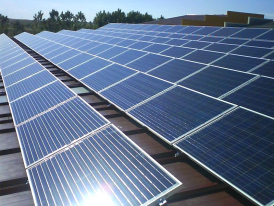



The government’s target of achieving energy independence and renewable energy utilization, in particular solar energy, should be equipped with thorough planning and implementation scheme, a government watchdog has warned.
The Institute for Essential Services Reform (IESR) assesses that President Prabowo Subianto’s ambition of achieving renewable energy within 10 years − although it may seem vague today − needs to be supported by planning and implementation beyond formal mechanisms, such as the Electricity Supply Business Plan (RUPTL), in order to increase the penetration of solar power plants.
In addition, the massive adoption of solar power plants needs to be supported by strengthening the solar power plant industry ecosystem through the development of an integrated and comprehensive roadmap to build an integrated solar power plant industry, from silica processing to silicon, to the manufacture of solar cells and modules. This is important to ensure the resilience and independence of the solar power plant industry amid geopolitical uncertainty.
IESR, in collaboration with the Indonesian Institute of Technology (ITI) and the National Research and Innovation Agency (BRIN), therefore recommends a Roadmap for an Integrated Photovoltaic Industry Supply Chain in Indonesia. This study contains five roadmaps and strategies to increase demand, production, policy framework alignment, key technology development, and job creation.
Chief Executive Officer of IESR, Fabby Tumiwa emphasized that global demand for photovoltaic technology will continue to increase in line with NZE targets in many countries. Innovations in solar cell technology are improving efficiency and reliability, thereby reducing technology costs. In addition, high global demand for solar power plants opens up opportunities for Indonesia to become an alternative to the supply chain that has been dominated by China.
“Countries in Asia, Europe, Africa, and Latin America are now seeking alternative supply chains, with logistics efficiency as a key consideration. Indonesia, located at the heart of Southeast Asia with access to Asia and the Pacific, has a significant opportunity to position itself as a solar power plant production hub in the region,” Fabby said as quoted in a statement on Wednesday, August 6, 2025.
“Beyond enhancing competitiveness, the development of domestic solar power plant industry and the export of this technology could become a new revenue source to replace coal, which is beginning to enter its decline phase,” he added.
The government’s 2025–2060 National Energy Policy targets increasing demand for solar power plants up to 108.7 GW by 2060. President Prabowo emphasized that renewable energy utilization, particularly solar energy, is a strategic step toward achieving energy independence, starting from rural areas. The president has even emphasized that Indonesia could achieve 100 percent renewable energy within 10 years, offering optimism based on Indonesia's renewable energy potential, with solar energy being the largest.
Fabby further highlighted that Indonesia has abundant critical minerals for the solar power industry. He urged the Downstream Task Force to make the development of minerals for clean energy technology a strategic priority in supporting the energy transition.
In addition to National Electricity General Plan (RUKN), Indonesia, through PLN's 2025–2034 RUPTL, is targeting a total installed capacity of 17.2 GW for solar power plants. The plan to export 3.5 GWac of electricity to Singapore also contributes to the increase in demand and production needs for solar power plants. However, to date, there is no domestic upstream photovoltaic industry, such as the production of polysilicon, ingots, and wafers, as well as low-iron tempered glass.
Alvin Putra Sisdwinugraha, an electricity system and renewable energy analyst at IESR, pointed out that this situation contrasts with the abundance of quartz sand reserves as raw material for polysilicon. Over 17 billion tons of quartz sand are distributed across Sumatra, Kalimantan, Sulawesi, and Nusa Tenggara.
IESR highlights that the abundance of silica raw materials, availability of labor, industrial zones, and renewable energy potential can reduce polysilicon production costs, which currently reach US$8-9 per kilogram.
On the downstream side, Indonesia already produces solar cells and modules. Domestic module production capacity currently stands at 10.6 GW, while solar cell capacity is 9.5 GW. However, utilization of factory production capacity remains relatively low due to low domestic demand. Additionally, improvements in efficiency and strengthening of the industrial ecosystem are still needed.
“The experience of domestic solar cell and module industry in producing at the gigawatt scale is a huge opportunity. Investment interest in the cell sector is also quite high. Module production has lower initial capital requirements and can be strengthened by the availability of supporting industries such as aluminum and glass, as well as the continuing upward trend in exports,” Alvin said.
The joint study proposes a strategy for developing the photovoltaic supply chain in three stages: short term (2025–2030), medium term (2031–2040), and long term (2041–2060). The study also recommends that the government strengthen the foundation of the national photovoltaic industry through the establishment of a strategic roadmap and the formation of a cross-sectoral working group, as concrete steps toward harmonizing investment, industrial, and strategic solar energy project policies, such as the green corridor to Singapore.
These efforts, the joint team said, also need to be supported by the provision of fiscal and non-fiscal incentives, improvements in procurement and tariff regulations, harmonization of import duties on supply chain components, and the establishment of price preferences to encourage the use of local modules.
At the regional and industrial levels, Indonesia needs to initiate cooperation within the AFTA framework, accelerate manufacturing automation for export readiness, promote the development of integrated research and development (R&D) centers, downstream processing of raw materials, and financing from national financial institutions to achieve tier-1 status. Foreign direct investment should be directed toward supporting technology transfer through licensing and innovation partnerships.
All these initiatives can be integrated through the formation of a national consortium, as a platform for synergy from upstream to downstream to build a highly competitive and sustainable solar industry the study said.
Already have an account? Sign In
-
Start reading
Freemium
-
Monthly Subscription
20% OFF$29.75
$37.19/MonthCancel anytime
This offer is open to all new subscribers!
Subscribe now -
Yearly Subscription
33% OFF$228.13
$340.5/YearCancel anytime
This offer is open to all new subscribers!
Subscribe now
Set up email notifications for these topics