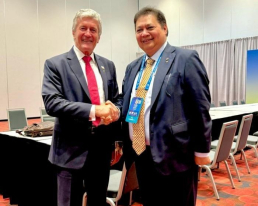


Coordinating Minister for the Econom, Airlangga Hartarto, inaugurated Indonesia’s first integrated aseptic packaging facility, PT Lami Packaging Indonesia (Lamipak), in Serang, Banten, on Friday, August 1, 2025.
The new facility is expected to support the government’s Free Nutritious Meal (MBG) program, particularly by streamlining the packaging of fresh milk.
Airlangga noted that Lamipak had increased its production capacity from 12 billion to 21 billion packages annually as of last month. With the plant occupying only 16 hectares − just 12 percent of its maximum capacity − the company could expand its output up to tenfold.
“In the future, we won’t need to import aseptic packaging anymore because Lamipak has great expansion potential. The total land area here exceeds 100 hectares,” Airlangga said.
Lamipak Indonesia Managing Director Anton Hui said the company would support the government’s MBG initiative, citing that domestic production would cut supply chain length and accelerate access to aseptic packaging, thereby helping reduce food and beverage prices in the country.
According to the Indonesian Food and Beverage Producers Association, packaging contributes around 30 percent to the production costs of processed beverages.
“Regarding MBG support, it now depends on the readiness of fresh milk producers and the government. To my knowledge, there are discussions about reducing the MBG budget,” Anton noted.
Anton, who has been involved in talks on the supply of fresh milk for the program, said the potential budget cuts have delayed agreements between the government and milk producers on pricing.
“We’re actively involved in these discussions, but so far there’s no concrete conclusion on fresh milk procurement. There’s still a lot of debate among producers,” he said.
Meanwhile, the Ministry of Agriculture reported that only 25,097 imported dairy cows − 12.5 percent of the 2025 target − have arrived in Indonesia so far. The delay in dairy investment is largely due to limited access to affordable land.
All idle state-owned lands are currently managed by state enterprises or ministries under land-use permits or cultivation rights. Agung Suganda, Director General of Livestock and Animal Health, said these arrangements often come with high rental costs, making livestock investment less feasible.
“There are still regulations at the State-Owned Enterprises Ministry and Forestry Ministry that cause land rental costs to be expensive and considered unviable for livestock investment,” Agung said in Cikarang, West Java, on July 14, 2025.
Agung explained that private investors are subject to high rental fees when using state-owned land. Although he did not elaborate on the specific regulations, he warned that such policies may hinder this year’s target of importing 100,000 dairy cows.
As of June 2025, 134 companies have pledged to import a total of 3 million dairy and beef cattle by 2029. So far, 110 entities have imported 350,000 beef cattle and 25,097 dairy cows.
Vietnam’s TH Group, which plans to import around 250,000 dairy cows annually − totaling 1.5 million by 2029 − has yet to begin operations due to land acquisition issues.
“We’re still negotiating land with TH Group, given the scale of their planned investment. This land issue remains our biggest challenge,” Agung said.
Already have an account? Sign In
-
Start reading
Freemium
-
Monthly Subscription
20% OFF$29.75
$37.19/MonthCancel anytime
This offer is open to all new subscribers!
Subscribe now -
Yearly Subscription
33% OFF$228.13
$340.5/YearCancel anytime
This offer is open to all new subscribers!
Subscribe now
Set up email notifications for these topics