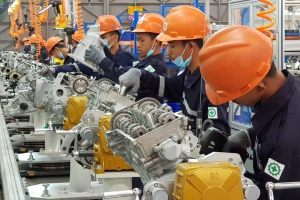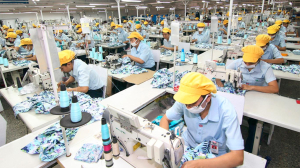



Indonesia’s manufacturing sector still faces difficulties competing with Vietnam in the U.S. market, despite lower import tariffs granted by the U.S. government, said Putu Juli Ardika, Director General of Agro Industry at the Ministry of Industry.
He emphasized that Vietnam maintains a stronger competitive edge due to lower production costs, particularly in energy and land.
“Energy costs in Vietnam are lower than in Indonesia, and land is also cheaper,” Putu said on Wednesday, July 30, 2025.
While the U.S. under President Donald Trump has imposed a 19 percent import tariff on Indonesian products, slightly lower than Vietnam’s 20 percent, Putu emphasized that this alone won’t be enough for Indonesia to outperform Vietnam − especially in industries like furniture manufacturing, where local production costs remain higher.
Still, Putu believes Indonesian furniture can become more competitive with strategic upgrades. One key solution is automation. The Indonesian Furniture and Craft Industry Association (HIMKI) estimates that the furniture industry needs US$1.8 billion (Rp30 trillion) in investments to boost exports and take advantage of the 19 percent U.S. tariff rate.
To support this, the government has introduced three financial assistance schemes:
● 5 percent interest subsidies on machinery purchases, part of the January–February economic stimulus package, with a Rp300 billion budget;
● Access to People’s Business Credit (KUR) with a 6 percent interest rate;
● A machinery modernization program, covering up to 40 percent of the machine’s purchase cost.
The government is also opening up non-traditional markets for furniture exports, including India and the Middle East, to diversify demand.
HIMKI chairman Abdul Sobur said that the Rp30 trillion investment is essential to modernize production and scale up output to meet U.S. demand. The goal is to double furniture exports to the U.S. from US$2.5 billion in 2025 to US$5 billion by 2028, which would equate to about 5 percent of the U.S. furniture market.
However, Sobur warned that 85 percent of Indonesian furniture manufacturers currently struggle to meet volume and deadline requirements from U.S. buyers. “We need technology investment, stable raw material supply, and a more efficient production model to maximize the benefit of the lower tariffs,” he told Katadata.co.id.
Of the US$1.8 billion in needed investment:
● US$800 million would replace outdated, semi-manual machines at 2,000 factories;
● US$500 million is needed to develop industrial forests, panel processing plants, and component factories, addressing the instability in raw materials like wood and rattan, which often face regulatory and supply issues.
Already have an account? Sign In
-
Start reading
Freemium
-
Monthly Subscription
20% OFF$29.75
$37.19/MonthCancel anytime
This offer is open to all new subscribers!
Subscribe now -
Yearly Subscription
33% OFF$228.13
$340.5/YearCancel anytime
This offer is open to all new subscribers!
Subscribe now
Set up email notifications for these topics