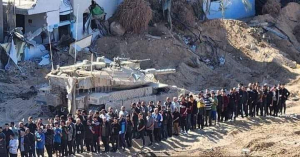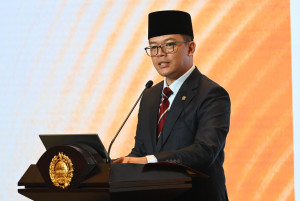



Former Indonesian President Susilo Bambang Yudhoyono (SBY) expressed deep concern over the humanitarian situation in Gaza and Palestine, emphasizing that it is exacerbating the phenomenon of dehumanization in global geopolitics.
"We are all witnessing how the people of Gaza and Palestine are living in deplorable conditions, with many casualties, especially among women and children," SBY said in a public speech titled with "World Disorder and the Future of Our Civilization” on Wednesday, July 30, 2025.
He cited that the prolonged conflict in Gaza and Palestine underscores the fragility of the current global civilization, where humanity continues to fall victim to ongoing injustice.
"We have witnessed immense suffering, not only in terms of the loss of life but also in the form of dehumanization − a process that undermines human dignity," he said.
The 6th Indonesian president also spoke about international community's responsibility to take firmer action against the suffering in Palestine and Gaza.
"Will the world continue to stand by and watch this tragedy, or will we act to stop the violence and achieve a just peace?" SBY asked..
Despite international efforts to ease tensions, SBY pointed out that there has been no adequate solution for the Palestinian people.
"We must ensure that the world sees this issue with empathy and the courage to act," he said. He also reminded that without a peace agreement that both parties can accept, the humanitarian crisis will only continue to grow and further damage global civilization.
The ongoing conflict between Israel and Hamas, which began on October 7, 2023, has escalated into one of the deadliest confrontations in the region's history. The initial Hamas-led attack resulted in the deaths of approximately 1,200 Israelis and the abduction of 251 individuals. In response, Israel launched a military offensive aimed at dismantling Hamas's infrastructure and securing the release of hostages.
As of July 29, 2025, the Gaza Health Ministry reports that over 60,000 Palestinians have been killed, with more than 145,000 injured. Among the casualties, over 18,500 are children, and nearly 9,800 are women.
The conflict has also led to widespread displacement, with approximately 90 percent of Gaza's 2 million residents forced to flee their homes. The humanitarian situation is dire, with severe shortages of food, medicine, and essential services as reported by AP.
Peace and justice
SBY emphasized that the solution to the Gaza and Palestine issue should not be limited to a temporary ceasefire but must be based on principles of justice and sustainable peace.
"True peace can only be achieved if justice is upheld and human rights are respected. We cannot focus solely on ending violence without considering the right of the Palestinian people to live freely and with dignity," SBY stressed.
He also pointed out that this conflict not only impacts Palestine and Israel but also affects the stability of the Middle East and the world as a whole.
"We must view the Gaza and Palestine issue as part of the global humanitarian crisis. This is a test for our civilization − whether we are capable of finding a solution that is rooted in empathy and justice," he added.
SBY then called on the nations of the world to work together in supporting the peace efforts in Palestine, emphasizing that unilateral actions would never be sufficient to resolve this long-standing issue.
"The world must unite in seeking a just solution that grants the Palestinian people the right to live in peace and have an independent state," he said.
Calls for UN reform
SBY also voiced his concerns about the United Nations' (UN) capacity to address modern-day challenges, with many advocating for comprehensive reforms. He emphasized the need for the UN to evolve in response to geopolitical shifts, technological advancements, and humanitarian crises.
“The UN must reform to remain relevant in today’s world,” he said, urging the international community to reevaluate the organization's structure and approach.
He highlighted that the UN, while playing a crucial role in global diplomacy, is often slow to act in the face of urgent crises.
Among the key issues discussed was the UN Security Council's outdated composition, which reflects the power dynamics of the post-World War II era rather than the current geopolitical realities.
“The world has changed, and so must the UN,” Yudhoyono said. “The UN must better represent the diverse and evolving power structures that now exist.”
He also pointed to the increasing importance of addressing climate change and global health issues, which he described as growing threats that the UN must tackle with greater urgency. He argued that the UN’s bureaucratic hurdles and lack of swift decision-making often hinder its ability to respond effectively to global crises.
“Global challenges like climate change, pandemics, and security threats require a UN that is agile and responsive,” he continued, adding that reforms are necessary to ensure that the UN can continue to lead global efforts for peace and stability.
The former president called on member states to work together to implement reforms that would make the UN more inclusive and effective.
In conclusion, Yudhoyono urged a renewed commitment to multilateralism and a stronger UN that can tackle pressing issues, such as climate change, international security, and economic inequality. "We must build a UN that is equipped to face the complexities of the modern world,” he said.
Already have an account? Sign In
-
Start reading
Freemium
-
Monthly Subscription
20% OFF$29.75
$37.19/MonthCancel anytime
This offer is open to all new subscribers!
Subscribe now -
Yearly Subscription
33% OFF$228.13
$340.5/YearCancel anytime
This offer is open to all new subscribers!
Subscribe now
Set up email notifications for these topics