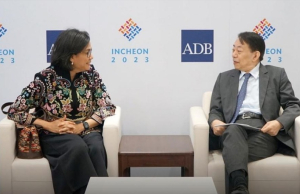



Asian Development Bank (ADB) President Masato Kanda has called on Southeast Asian nations, including Indonesia, to turn rising global economic uncertainty and trade tensions intensified by U.S. President Donald Trump’s tariff policies into opportunities for deep domestic reform and economic modernization.
“This is a difficult time for many nations. But it’s also a chance to implement major reforms − particularly to modernize local economies and reduce dependence on external forces,” Kanda said during a visit to the Sengkol Solar Power Plant in Central Lombok, West Nusa Tenggara on Monday, July 21, 2025.
Kanda, a former Japanese Vice Minister of Finance for International Affairs, outlined a core strategy for resilience: industrial diversification into more competitive sectors, combined with supply chain optimization.
“This will ultimately strengthen competitive industries and foster sustainable growth,” he said.
In addition to structural reforms, Kanda emphasized the need for stable macroeconomic policies, particularly fiscal discipline, to withstand external shocks. He also advocated for strengthening regional cooperation, not only within ASEAN but across other international regions, to enhance collective resilience.
Kanda reaffirmed ADB’s commitment to working closely with governments across the region, saying the institution will continue to boost collaboration and provide support to help countries navigate the current volatility.
“We believe today’s challenges can become tomorrow’s foundation for stronger, more united economies,” he said.
Indonesia’s economic outlook
According to the Asian Development Outlook (ADO) April 2025 report, ADB projects Indonesia’s economy will grow by 5 percent in 2025, rising slightly to 5.1 percent in 2026.
This growth is expected to be driven primarily by stable private consumption and gradual investment recovery, with strong community-based social spending ensuring more equitable income distribution.
“Domestic demand will remain the key driver of growth, offsetting limited net exports,” ADB Chief Economist Albert Park said based on the report.
Park highlighted that Indonesia’s growth will be supported by sectors such as manufacturing, agriculture, and services, particularly retail trade, transportation, and logistics, all of which benefit from rising domestic demand.
Already have an account? Sign In
-
Start reading
Freemium
-
Monthly Subscription
20% OFF$29.75
$37.19/MonthCancel anytime
This offer is open to all new subscribers!
Subscribe now -
Yearly Subscription
33% OFF$228.13
$340.5/YearCancel anytime
This offer is open to all new subscribers!
Subscribe now
Set up email notifications for these topics