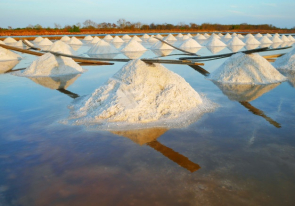



State-owned salt producer PT Garam is addressing concerns from the food processing industry over the quality of locally produced salt, following multiple failed trials that led to damaged products as the issue lies not solely in the salt itself, but also in the technology used by processing plants.
“Most salt processing industries today use machines designed for high-purity salt. These machines typically perform only two purification cycles or backwashing processes to separate contaminants from salt. Using local salt with these machines simply won’t work unless we first increase the salt’s purity,” PT Garam President Director Abraham Mose told a press conference at the Ministry of Marine Affairs and Fisheries on Wednesday, June 11, 2025.
The Indonesian Food and Beverage Producers Association (GAPMMI) previously said that local salt is currently unsuitable for use in the food and beverage sector, citing early trials where up to 60 percent of products were damaged due to the use of domestic salt.
Mose acknowledged the issue and confirmed that stakeholders are actively working to improve the quality of domestic salt. To meet industrial-grade standards, salt needs to be processed from brine with a higher Baume index − ideally up to 29. Currently, domestic brine averages only 23–25 degrees Baume, requiring extra steps to reach the required purity level, especially for crystallization.
“Industrial salt production is currently expensive because we need to raise the brine’s Baume level. That’s why we are developing our own machinery model to support this process,” Mose said.
Meanwhile, Director General of Marine Affairs Management at the Ministry of Marine Affairs and Fisheries, A. Koswara, reaffirmed that local salt − especially from East Nusa Tenggara (NTT) − can achieve up to 99 percent purity, making it suitable even for the pharmaceutical industry, which demands the highest salt quality. For reference, the required purity for chlor-alkali is 97 percent, while the food industry requires at least 95 percent.
Koswara believes that the advanced mechanized processes planned for the National Salt Industry Zone (K-SIGN) in Rote Ndao will significantly boost the production of high-quality salt for domestic manufacturing sectors. The government is set to begin construction of one of the ten industrial zones next month, with an investment of Rp750 billion (US$46 million) for the initial zone focused on industrial salt production.
This zone is expected to begin operations by the end of this year, with the remaining nine zones slated for investor development and full operation by 2027. Koswara projects that K-SIGN will help reduce salt imports for manufacturing by approximately 600,000 tons annually between 2025 and 2027. As a result, industrial salt imports could drop from 2.6 million tons in 2024 to 1.8 million tons in 2025 and cease entirely by 2028.
“With production capacity reaching up to 3 million tons per year, the National Salt Industry Zone in Rote has the potential to fully replace Indonesia’s annual industrial salt imports,” he said.
Already have an account? Sign In
-
Start reading
Freemium
-
Monthly Subscription
20% OFF$29.75
$37.19/MonthCancel anytime
This offer is open to all new subscribers!
Subscribe now -
Yearly Subscription
33% OFF$228.13
$340.5/YearCancel anytime
This offer is open to all new subscribers!
Subscribe now
Set up email notifications for these topics