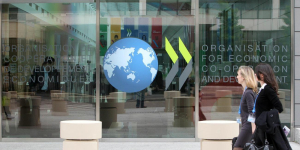


Indonesia’s aspirations to join the Organization for Economic Cooperation and Development (OECD) are making significant headway after the government has officially submitted its initial memorandum, a key milestone in the accession process.
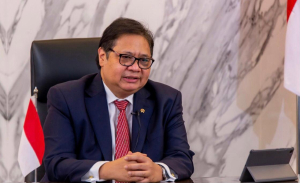
“This is significant because Indonesia is the first Southeast Asian country to submit an accession request and the initial memorandum,” Coordinating Minister for the Economy told a teleconference from France on Wednesday evening, June 4, 2025, Jakarta time.
The government has outlined a four-year timeline to complete the accession process. With the first year already underway, the upcoming two years will focus heavily on technical reviews, involving multiple ministries and government agencies.
Airlangga expressed optimism that Indonesia’s accession could proceed faster than other countries, citing Brazil as an example, which has been in the process for five years. Some nations, he noted, have taken up to a decade to join the OECD.
Once the initial memorandum has been submitted, a technical team will be formed to continue discussions on necessary policy alignments across various sectors. Priority areas include anti-corruption measures, trade, investment regulations, and environmental policies.
Airlangga highlighted that Indonesia may progress more swiftly through the accession process due to the fact that many of its financial and fiscal policies are already aligned with OECD standards. Additionally, Indonesia has experience in applying OECD norms through its past collaborations with Japan.
“Indonesia already has financial standards in place, and 90 percent of the financial sector review results are largely aligned, including fiscal and macroprudential policies,” he said.
One key requirement for Indonesia's accession is the ratification of the OECD Anti-Bribery Convention. Airlangga stated that the government has requested the Corruption Eradication Commission (KPK) to prepare for this ratification. The KPK has expressed its commitment to adopting the international agreement, which addresses corporate cross-border corruption.
Should Indonesia be accepted as a member, Airlangga outlined several benefits the country stands to gain. For micro, small, and medium enterprises (MSMEs), OECD membership could support a transition from the informal to the formal economy. In the education sector, standardized learning benchmarks equivalent to those in other OECD countries could be adopted in Indonesian high schools.
In healthcare, OECD membership would encourage the development of resilient and inclusive health systems, providing universal services across member states. Furthermore, Indonesia would participate in global efforts to promote clean governance and anti-bribery initiatives, in line with the anti-bribery convention.
Additional advantages include advancements in digitalization and artificial intelligence, and the adoption of the OECD’s doing business standards, which are updated regularly and widely regarded as benchmarks for ease of doing business.
“Indonesia will certainly craft policies that reflect the interests of Global South countries, as we aim to consistently contribute to improving global policy standards,” Airlangga concluded.
Already have an account? Sign In
-
Start reading
Freemium
-
Monthly Subscription
20% OFF$29.75
$37.19/MonthCancel anytime
This offer is open to all new subscribers!
Subscribe now -
Yearly Subscription
33% OFF$228.13
$340.5/YearCancel anytime
This offer is open to all new subscribers!
Subscribe now
Set up email notifications for these topics