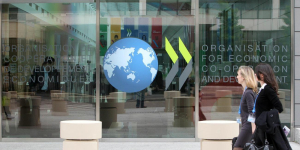



Global economic growth is expected to lose momentum over the next two years as geopolitical tensions, financial vulnerabilities, and weakening labor markets weigh on the outlook, according to the Organisation for Economic Cooperation and Development (OECD).
In its latest Economic Outlook released on Wednesday, December 3, 2025, the Paris-based organization projected global growth to decelerate from 3.2 percent in 2025 to 2.9percent in 2026, before gradually recovering to 3.1 percent in 2027.
The OECD noted that the world economy has performed better than originally anticipated, supported by improved financial conditions, rising investment, AI-driven trade, and generally accommodative macroeconomic policies.
“The global economy has proven more resilient than expected this year,” the report said.
Despite relative resilience, the OECD warned of emerging weaknesses. Labor markets are showing early signs of softening: unemployment remains steady at 4.9 percent, yet job vacancies in many advanced economies have fallen below pre-pandemic levels, while business and consumer sentiment continue to erode.
Risks to the global outlook remain “significant,” including persistent trade frictions particularly those originating from the United States volatile crypto asset markets, and the potential for abrupt repricing in financial markets, exacerbated by mounting pressure on non-bank financial institutions.
“Lingering fiscal concerns could push long-term bond yields higher, tightening financial conditions and raising debt-servicing burdens,” the OECD warned.
The report also highlighted that elevated tariffs will continue to restrain short-term activity as their gradual impact further drags on investment and trade amid persistent geopolitical and policy uncertainty.
A rebound is expected only toward late 2026, supported by easing tariff pressures, improving financial conditions, and declining inflation. Developing economies in Asia are projected to remain the main drivers of global growth.
‘Whirlwind year’
Coordinating Minister of the Economy Airlangga Hartarto described 2025 as a “whirlwind year”, citing overlapping global crises that continue to destabilize markets.
He pointed to ongoing trade conflicts between major economies, the Israel–Iran confrontation, the protracted Gaza crisis, and Russia’s invasion of Ukraine as key sources of global uncertainty.
“This year is full of headwinds l, a whirlwind year,” Airlangga said at the National Leadership Meeting of the Indonesian Chamber of Commerce and Industry (KADIN) in Jakarta on Monday, December 1, 2025.
“Tariff wars, the Israel–Iran conflict, unresolved tensions in Gaza, and the Russia–Ukraine war all contribute to global instability,” he added.
Despite mounting external pressures, Airlangga emphasized that Indonesia’s economy remains resilient, supported by stable macroeconomic conditions, sustained household consumption, and a relatively steady exchange rate compared to many emerging economies.
He noted that monetary easing has begun to support growth momentum. “We have restarted the economy in the third quarter, with Bank Indonesia cutting interest rates by 125 basis points this year, helping to revive economic activity,” he said.
Already have an account? Sign In
-
Start reading
Freemium
-
Monthly Subscription
20% OFF$29.75
$37.19/MonthCancel anytime
This offer is open to all new subscribers!
Subscribe now -
Yearly Subscription
33% OFF$228.13
$340.5/YearCancel anytime
This offer is open to all new subscribers!
Subscribe now
Set up email notifications for these topics