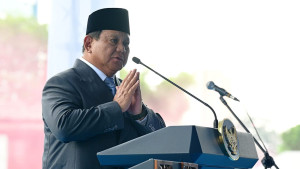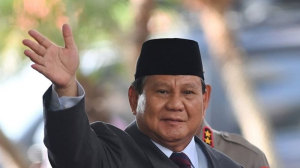



In his first year in office, President Prabowo Subianto has exercised four presidential prerogatives to overturn or correct criminal decisions ‒ a series of moves that has divided legal experts and ignited renewed scrutiny of Indonesia’s judicial integrity, particularly in corruption cases.
Prabowo has granted clemency and rehabilitation to several individuals, including former Trade Minister Tom Lembong, who received an abolition order, and Indonesian Democratic Party of Struggle (PDI-P) Secretary-General Hasto Kristiyanto, who was granted amnesty.
Two public high school teachers in North Luwu ‒ Rasnal and Abdul Muis Muharram ‒ were also rehabilitated after facing charges related to alleged improper school committee fees.
Most recently, Prabowo issued rehabilitation for three former executives of state-owned ferry operator PT ASDP ‒ Ira Puspadewi, Yusuf Hadi, and Harry Muhammad Adhi Caksono ‒ who were convicted in a controversial corruption case involving the acquisition of PT Jembatan Nusantara shares.
Legal balance
Criminal law expert from Tarumanagara University, Hery Firmansyah, said the president’s actions remain within legal boundaries, but warned that too frequent intervention could damage public trust in law enforcement institutions.
“It will become counterproductive if this is done too often, as it may affect public confidence in the performance of law enforcers such as the KPK (Corruption Eradication Commission),” Hery said on Wednesday, November 26, 2025.
He cautioned that excessive reliance on presidential intervention could disrupt the balance of power within Indonesia’s trias politica system, making the judiciary, prosecutors, and anti-graft bodies feel undermined.
Hery stressed that Indonesia’s judicial system already provides multiple levels of correction ‒ appeals at higher court and the Supreme Court, and judicial review.
“Ideally, legal issues should be resolved through legal channels to ensure a comprehensive corrective process,” he said.
He criticized cases that proceed to trial despite weak legal foundations, saying investigations should be halted early if criminal elements are not met.
“If from the start the case does not meet criminal requirements, it should be stopped. Do not let it progress too far only to later provide rehabilitation and other remedies,” Hery said.
Similar concerns were shared by Lisra Sukur, a researcher at the Indonesian Institute for Judicial Independence Research and Advocacy (LeIP), who suggested the repeated use of pardon powers reveals deeper judicial problems.
He noted that cases involving Lembong, the Luwu Utara teachers, and the ASDP executives had raised significant public questions from the beginning.
“The President is given an exclusive right to grant clemency because one day it may be required in situations of wrongful justice,” Lisra, also known as Arsil, said.
He argued that Indonesia’s corruption law, especially Articles 2(1) and 3 of the 2001 Anti-Corruption Act, often leads to legal uncertainty. He said defendants are sometimes prosecuted without clear standards of personal gain.
He cited that corruption cases are frequently framed around claimed state losses rather than illegal benefits obtained, opening room for criminalization of policy decisions rather than wrongdoing.
“Officials struggle to distinguish whether a business decision they make could later be considered corruption. Once they leave office, they may suddenly face prosecution,” he warned.
ASDP case
The three former ASDP executives were found guilty in connection with the 2019–2022 acquisition of aging vessels belonging to PT Jembatan Nusantara. Prosecutors alleged a state loss of Rp1.25 trillion (US$75 million) due to ships being in poor condition, even sunken.
The Anti-Corruption Court sentenced former managing director Ira Puspadewi to four years and six months ‒ significantly below the 8.5-year demand. However, the court also concluded that none of the defendants personally benefited financially from the transaction.
Under Indonesian law, rehabilitation restores the legal rights and status of a defendant once a final ruling declares them free from criminal charges.
While some see Prabowo’s decisions as necessary checks against flawed judicial processes, others fear it may weaken anti-corruption efforts and generate reliance on presidential benevolence.
As public reaction builds, analysts agree on one point: Indonesia now faces a critical moment to reevaluate and reform its justice system ‒ ensuring that legal remedies remain the rule, not the exception.
Already have an account? Sign In
-
Start reading
Freemium
-
Monthly Subscription
20% OFF$29.75
$37.19/MonthCancel anytime
This offer is open to all new subscribers!
Subscribe now -
Yearly Subscription
33% OFF$228.13
$340.5/YearCancel anytime
This offer is open to all new subscribers!
Subscribe now
Set up email notifications for these topics