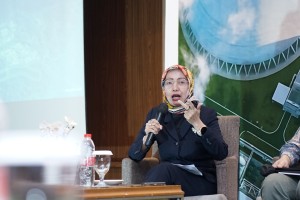



PLN Enjiniring is stepping into a pivotal role in reshaping the power supply of Indonesia’s remote and island regions. Speaking at the Electricity Connects Indonesia Conference 2025, Chairani Rachmatullah, President Director of PLN Enjiniring, outlined how the company, acting as the technical and engineering arm of the PLN Group, is leading the transition away from high-cost diesel systems toward hybrid renewable solutions. Meanwhile, PLN, as the owner and operator of the national electricity system, is establishing policy direction and preparing the investment framework needed to scale this transformation.
Restructuring legacy diesel systems
Across thousands of isolated grids, diesel generators remain the dominant power source. Chairani explained that these legacy systems are no longer financially viable, burdened by volatile fuel prices, complex logistics, and unstable supply. In response, PLN Enjiniring is taking on the engineering and redesign responsibilities under the national de-dieselization program, targeting more than 5,200 diesel units in over 2,000 locations for conversion into hybrid solar-plus-battery systems. PLN, in turn, provides the mandate, asset ownership, and strategic guidance for the nationwide transition.
According to Chairani, the company’s ambitions extend well beyond individual projects:
“PLN Enjiniring’s long-term objective for hybrid microgrid deployment is to establish a scalable, reliable, and economically viable distributed energy ecosystem that strengthens electrification in remote and islanded regions while accelerating the national energy transition.”
She added that in the next five to ten years, the strategy is expected to evolve from pilot initiatives to a national framework capable of supporting higher renewable penetration and advanced system controls across hundreds of sites.
Economic logic behind hybrid microgrids
Diesel-based generation in remote areas remains one of the most expensive power sources in PLN’s national portfolio. Through its technical and economic analyses, PLN Enjiniring has shown that hybrid microgrids can significantly reduce operational fuel costs, improve reliability, and ensure more predictable long-term expenditures. These findings reinforce PLN Enjiniring’s efforts to attract private capital and technology partners, while also supporting PLN’s role in shaping investment policy and regulatory alignment.
Chairani noted that financial structuring is entering a new stage:
“PLN, supported by PLN Enjiniring, is preparing an investment framework that builds upon the initial project value of approximately USD 0.6 billion under Phase I,” she said, adding that investment requirements are expected to expand significantly as more diesel-based systems transition to hybrid configurations.
Pilot sites as proof of concept
Two initial pilot sites, Nusa Penida and Bawean, are serving as living laboratories for hybrid microgrid development. Led by PLN Enjiniring, these pilots integrate automation, renewable forecasting, and adaptive dispatch to balance variable solar generation with remaining diesel units. The operational blueprint developed through these pilots will later be replicated across other regions by PLN, helping to enhance system reliability while reducing fossil fuel dependence.
Regulatory turning point: revision of Presidential Decree 112
A major factor shaping the pace of hybrid microgrid expansion is the ongoing revision of Presidential Decree (Perpres) 112/2022, which governs renewable energy pricing and procurement. The updated framework is expected to guide PLN in integrating hybrid systems into national electricity planning, particularly in isolated areas where generation costs differ sharply from the main grid. PLN Enjiniring contributes technical insights to support PLN’s adaptation to the new regulatory landscape.
Market observers view the revised regulation as an important step toward enabling more structured investment participation in remote solar and battery projects, creating a more stable environment for long-term financing.
A new phase of partnerships
Chairani confirmed that PLN Enjiniring intends to expand partnerships through multi-format investment collaboration:
“To realize these ambitions, PLN aims to strengthen partnerships through Build-Own-Operate schemes, co-ownership structures, and strategic collaborations with technology providers and financial institutions.”
She emphasized that partners would be essential in delivering both technological and financial certainty as hybrid microgrids scale nationwide.
Already have an account? Sign In
-
Start reading
Freemium
-
Monthly Subscription
20% OFF$29.75
$37.19/MonthCancel anytime
This offer is open to all new subscribers!
Subscribe now -
Yearly Subscription
33% OFF$228.13
$340.5/YearCancel anytime
This offer is open to all new subscribers!
Subscribe now
Set up email notifications for these topics