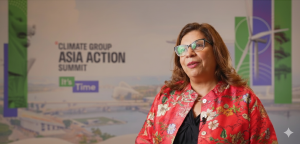


Elizabeth Yee serves as the Rockefeller Foundation’s Executive Vice President for Programs, where she leads the foundation’s global initiatives, regional operations, partnerships, and learning & impact efforts. She joined the organization in 2019 as Managing Director for Climate and Resilience, later taking on the role of Chief of Staff. Prior to that, she held senior positions at 100 Resilient Cities and built a 17-year career in infrastructure finance with Morgan Stanley, Lehman Brothers, and Barclays, where she completed more than $30 billion worth of transactions.
Liz, thank you for joining us. Philanthropy has long been associated with humanitarian goals, but today it also shapes influence and access. How does The Rockefeller Foundation reconcile its legacy as a global philanthropic leader with a world now driven by geopolitics, competition, and strategic interests rather than cooperation?
You’re right, competition, geopolitical rivalry and fragmentation are very much how the world feels right now. Our job as a philanthropy is that we are in the business of people. We try to make people’s lives better so they can thrive today and for generations to come.
We believe cooperation is essential, the prevailing view is that people don’t want to cooperate, but our polling of 36,000 people in 34 countries showed something different: 55% want more cooperation, even at some cost to their own self-interest, because they know it’s better for the world.
In Asia, especially Southeast Asia, that number is even higher, around 77%. So there is more hope and desire for cooperation than we often assume.
In reality, though, geopolitical tensions often come from governments. Do you work with governments to help make cooperation possible?
I think it takes all parts of society. We certainly work with and learn from governments to understand their priorities, because policy shapes people’s daily lives. We also work with the private sector, civil society and other philanthropies.
We aim to bring all of these actors together to tackle big problems like energy access. If we can understand what’s working in one context, we can adapt it elsewhere. The ability to provide resources to solve the problem is a key role for philanthropy.
The Rockefeller Foundation has also influenced global policy on SDGs, health systems, and climate resilience. How do you balance that influence responsibly and stay accountable to communities?
We work very intentionally at the local level. I often think of our role as a “sandwich”: we’re at both ends of the bread, working with high-level policy and also very local actors, trying to support what’s in the middle. In the U.S., for example, we’ve worked with 21 different administrations. Politics changes, but what matters to us is that people have agency and economic security so they can thrive.
We also invest in young leaders. Our Big Bets Fellows in Latin America, the U.S. and here in Asia-Pacific are both guiding our thinking and serving as symbols of hope, because they show what is possible on the ground.
Indonesia is now at the crossroads of democracy, development and the emerging voice of the Global South. What makes Indonesia strategically important for the Rockefeller Foundation, and how do your recent partnerships reflect its growing role?
Indonesia has been part of the Foundation’s story for a long time. Our first grant here was around 1917, focused on hookworm and sanitation. We did work with universities in the 1960s, and my own work in Indonesia began in the 2000s on urbanization.
I helped support Semarang’s Bus Rapid Transit system through 100 Resilient Cities, because connecting communities was key to building resilience. So Indonesia has been at the heart of a lot of what we’ve done.
Today, we’re working on climate and health, given heat risk and pandemic risk, on energy access to support Indonesia’s renewable energy vision, and on food systems transformation, food security and regenerative agriculture. Indonesia has been a strong partner, and we hope we’ve been a good partner in supporting its development goals.
You mentioned catalytic philanthropy. With so many ideas and projects, how do you use philanthropic capital to unlock larger public and private investment? How do you decide which initiatives have the highest catalytic potential, and what tells you an idea is ready to scale?
We receive more ideas than we can fund, so we focus where we know we can add real value. Our core areas are energy, food systems transformation and health; always looking at where finance and data can lift opportunities in those spaces.
When those elements align with a country’s ambitions and with what communities want, we know there’s something special. One example is the Global Energy Alliance for People and Planet.
In Indonesia, the cold chain has been a big challenge given the size of the agricultural and aquaculture economy. We’ve worked with fishing communities to support clean energy and battery storage so they can maintain a cold chain, preserve fish, improve food security and strengthen livelihoods.
We also look for replication potential. We want projects to be blueprints that can be modeled again and again, in Indonesia and elsewhere. And we never want to be the only funder. Our capital alone can’t solve these problems, so we aim to be catalytic, going first and taking risk, and then seeing partners like ADB or IFC come in to scale solutions.
You said Asia is moving from recipient to generator of solutions. Is Asia ready to redefine the rules of development, and how does Rockefeller share agenda-setting power with emerging Asian philanthropies?
We wanted to better understand Asian philanthropy, so we funded a Bridgespan report. One striking finding was that about 50% of Asian philanthropy has been created in the last 20 years, compared with 20% in the rest of the world. The speed and scale of wealth creation, and thus philanthropic capital, in Asia is unprecedented.
That also means philanthropy here is younger and often very future-oriented. Asian philanthropies are heavily interested in a green future: climate innovation, renewable energy, food systems transition, health, all areas we’ve worked in for a long time.
We collaborate closely with place-based philanthropies like the Hong Kong Jockey Club on climate and health, and with regional partners such as Temasek Foundation and AVPN. We try to approach these relationships with humility, recognizing where our history and networks can be helpful and where local actors should lead. Our goal is to work together to drive outcomes, not to dictate the agenda.
Many developing countries, like Indonesia, face a dilemma between rapid growth and sustainable transition. Indonesia is still heavily dependent on coal. How does Rockefeller design climate initiatives that align environmental goals with economic realities in such markets?
It’s a crucial question. Under our Power initiative, we have a program called Coal to Clean. In the Philippines, for example, we’re working in South Luzon with ACEN Corporation and other private sector partners, as well as communities and government, to figure out how to financially transition a coal plant to renewable energy.
The Philippines has a very thin power reserve margin, so you can’t just shut down generation without risking blackouts. Any transition has to be carefully sequenced so it doesn’t disrupt the grid, and it must consider workers and communities that rely on that plant for their livelihoods.
Our role is to support the analysis and community transition planning so that, hopefully, the plant can move from coal to solar in the coming years. We see similar opportunities in Indonesia, our team is working with PLN and the Cirebon plant on that.
Many people wonder: how do foundations really work financially? Is there any objective to make profit?
When I entered philanthropy, I assumed every foundation had an endowment, that’s not true. In our case, The Rockefeller Foundation was endowed in 1913 by John D. Rockefeller. Today, we have roughly 6 to 6.5 billion dollars in our endowment, which funds our grant-making each year.
We are not looking to profit, and we don’t ask anyone to pay us or give us money. That gives us the privilege to take risks and to be bold in how we partner with others to create opportunity in the world.
One of the greatest compliments we can receive is when another partner says, “We want to work with you” or “We want to co-fund this with you.” That collaborative philanthropy is, in a sense, how we “profit”, because it means we can achieve much more together, using the platforms, capital, grantees and networks we bring into the partnership.
On a personal note, what is one thing you could talk about for hours?
Women’s sports. I’m a very passionate women’s sports fan.
I spent about 20 years in investment banking, a very male-dominated industry, and led many women’s initiatives. Later, in philanthropy, I helped create Co-Impact and set up the world’s largest gender fund, because we saw how women and girls were being left behind. The evidence is clear: when you put women in leadership roles and ground them in law, policy and economic knowledge, you change outcomes for communities.
I’m still deeply impatient about the pace of change, which partly explains my interest in women’s sports. The pay gap in sports is a very visible example of gender inequity, and for me it has become another route to push change faster.
If you could have dinner with three people, living or deceased, who would they be?
First, my grandmother. I didn’t capture enough of her story and we didn’t write it down, so there’s a lot I don’t know and would love to ask her.
Second, the current Pope. I have many questions, about how he sees the world, what the conclave was like, his vision and how he thinks about values and bridge-building between faiths. We spend a lot of time talking about “unlikely partnerships,” and faith is one place where shared values can be very powerful.
Third, Trevor Noah. He has a unique ability to make very hard topics funny and accessible. In a world where storytelling, emotion, humor and trusted messengers matter as much as data and white papers, I would love to understand his craft.
What qualities do you most admire in a person?
Curiosity. Courage. Kindness.
Tag
Already have an account? Sign In
-
Start reading
Freemium
-
Monthly Subscription
20% OFF$29.75
$37.19/MonthCancel anytime
This offer is open to all new subscribers!
Subscribe now -
Yearly Subscription
33% OFF$228.13
$340.5/YearCancel anytime
This offer is open to all new subscribers!
Subscribe now
Set up email notifications for these topics