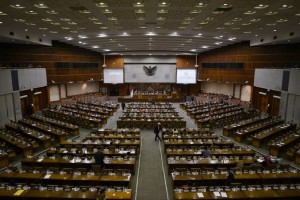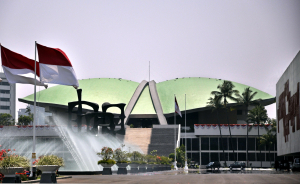



The House of Representatives (DPR) on Tuesday, November 18, 2025, passed the long-debated Bill on Criminal Code Procedure Bill (RKUHAP), clearing the final legislative hurdle despite persistent concerns from civil society groups over expanded police powers and weakened oversight mechanisms.
The bill was approved during a plenary session presided by House Speaker Puan Maharani after law Commission III chairman Habiburokhman delivered the committee’s final report. The new code will replace Indonesia’s four-decades-old 1981 Criminal Code Procedure (KUHAP), which has long been criticized for failing to prevent abuse in the criminal justice system.
Puan urged the public not to be swayed by what she described as misinformation circulating online about the contents of the new law.
“The explanation provided by House’s Commission III is clear and easy to understand. Those hoaxes are simply not true. We hope misunderstandings can be resolved together,” she said.
Ahead of the vote, Commission III lawmakers pushed back against allegations that the deliberation lacked meaningful public participation. Several members had been reported to the House Ethics Council (MKD) for allegedly sidelining civil groups during drafting.
Commission III chairman Habiburokhman rejected the claims as unfounded, insisting that civil society input dominated the final document.
“Ninety-nine point ninety-nine percent of the content reflects input from civil society. Accusations of manipulation or name-dropping are baseless,” he said.
He cited that although the working committee (Panja) had completed deliberations in early July, the formulation and synchronization teams decided to reopen discussions to absorb additional feedback. Nearly 100 civil-society organizations, he said, participated in discussions held between July and early November.
Their proposals included removing restrictions on media coverage (submitted by the Alliance of Independent Journalists), expanding rights for persons with disabilities, and widening the scope of pretrial challenges (ICJR). Commission III also incorporated academic recommendations, particularly provisions aimed at preventing torture and intimidation during interrogations.
“Not every sentence was taken verbatim, but the substance is reflected,” Habiburokhman noted.
“Superpower police”
Despite the government’s reassurances, the Civil Society Coalition for Police Reform has maintained firm opposition, arguing that the RKUHAP threatens Indonesia’s democracy by expanding police discretion while weakening oversight.
In a statement, the coalition said the law “risks entrenching impunity” and could reinforce systemic problems documented under the previous KUHAP −wrongful arrests, torture, fabricated cases, criminalization, and discrimination.
They warned that instead of reforming the police, the new code could “shut the door to meaningful police reform” and undermine accountability in law enforcement.
With the RKUHAP now passed, the government and DPR are expected to draft derivative regulations, including a separate law to regulate wiretapping procedures.
Legal observers say these upcoming regulations will be decisive in shaping how the new criminal procedure system affects civil liberties, due process, and police accountability.
Whether the new KUHAP becomes a milestone for justice reform or a setback for human rights, they say, will depend on how the details are implemented in months ahead.
Public criticism
Much of the public criticism has stemmed from a viral poster alleging that the new RKUHAP enables police to conduct intrusive actions, such as surveillance, device seizure, and arrest without judicial oversight.
“That poster is entirely a hoax,” Habiburokhman said.
He highlighted several provisions to argue that police powers remain under judicial control:
* Wiretapping will be governed by a separate law, as outlined in Article 135(2).
* Account freezing, digital-data access, and social-media blocking require a court order (Article 139(2)).
* Seizures must receive authorization from the district court chief (Article 44).
* Arrests and detentions must follow formal designation as a suspect supported by at least two pieces of evidence and meet stricter, “more objective” criteria than the 1981 KUHAP.
Under Articles 93 and 99, arrest or detention is permitted only in specific circumstances, including ignoring two consecutive summonses, obstructing investigation, attempting to flee, influencing witnesses, destroying evidence, or facing security threats conduct categorized as obstruction of justice.
According to Habiburokhman, the tighter requirements would prevent questionable detentions seen in previous years.
He cited the case of former minister Roy Suryo, saying that under the new code, his case would likely have been resolved through restorative justice rather than detention.
Tag
Already have an account? Sign In
-
Start reading
Freemium
-
Monthly Subscription
20% OFF$29.75
$37.19/MonthCancel anytime
This offer is open to all new subscribers!
Subscribe now -
Yearly Subscription
33% OFF$228.13
$340.5/YearCancel anytime
This offer is open to all new subscribers!
Subscribe now
Set up email notifications for these topics