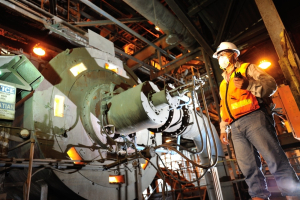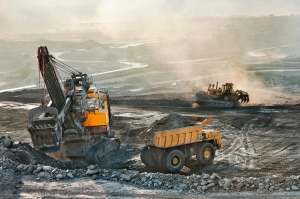


The Association of Indonesian Energy, Mineral, and Coal Suppliers (Aspebindo) has called for price adjustments and regulatory reforms to support coal producers and accelerate Indonesia’s energy transition amidst rising production costs, tight margins, and persistent infrastructure gaps.
Addressing the Aspebindo Energy Executive Forum on Monday, November 17, 2025, Aspebindo Chairman Anggawira said coal industry had not seen meaningful price adjustments for nearly eight years, putting pressure on mining companies and limiting supply flexibility for state power utility PLN.
“PLN is finding it difficult to secure coal because the price no longer matches production conditions. With rising stripping ratios and increasing operational costs, we hope there will be an adjustment perhaps an increase of around US$10 to US$20 per metric ton to ensure producers can continue supplying domestic needs,” Anggawira said.
He emphasized that coal still underpins Indonesia’s electrification, particularly through independent power producers (IPPs), making supportive policies crucial even as the government advances its downstreaming and energy-transition agenda.
He stressed that downstreaming cannot succeed unless coal producers maintain adequate margins to reinvest in innovation, collaboration, and new technologies.
“Downstreaming requires margin. Without it, how can the industry move forward? If margin is available, we can drive synergy, collaboration, and innovation,” he said.
He also highlighted ongoing government strategies to boost domestic oil and gas output particularly through optimization of community wells and accelerated exploration hoping the national lifting target can be reached this year.
Infrastructure bottlenecks
Executive Director of the Petrominer Institute, Komaidi Notonegoro, warned that Indonesia’s economic and energy growth targets will be difficult to meet without major improvements in gas and power infrastructure.
“If the economy wants to grow 1 percent, energy must grow 1.5 to 2 percent. So with an 8 percent economic target, the energy sector must grow 12 percent to 16percent,” Komaidi told reporters.
Komaidi noted that Indonesia’s energy mix remains 86–87 percent fossil-based, consisting of coal, oil, and gas. Gas, he said, is the most environmentally favorable transitional fuel and could cut energy-sector CO₂ emissions by around 50 percent if it replaces half of current coal and oil consumption.
“But the biggest challenge is infrastructure and connectivity,” he said.
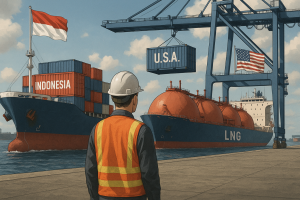
He cited unfinished pipeline projects such as the CISEM (Cirebon–Semarang) route and the lack of a fully connected Sumatra corridor, forcing Indonesia to rely on LNG whose cost can triple due to the liquefaction, transport, and regasification processes.
Komaidi pointed to PLN’s monopoly over power transmission as a major barrier to renewable energy expansion. Under current rules, renewable energy producers cannot sell electricity directly to buyers but must go through PLN, which often prioritizes cheaper coal-based supply.
“Coal costs about Rp600–800 per kWh, while renewables exceed Rp1,500. From a business standpoint, PLN has no incentive to buy renewables,” he said.
He added that many multinational companies are ready to purchase renewable electricity, but transactions are blocked by lack of transmission access and the single off-taker system which makes PLN the only buyer, creating a monopsony.
Power wheeling
To resolve the bottleneck, Komaidi reiterated calls for power wheeling, which would open access to PLN’s transmission network and allow renewable producers to sell power directly to customers by paying a transmission fee.
He compared it to a toll road: “Why build a new toll road next to Jagorawi? It’s more efficient to let others use the existing road and pay a reasonable tariff.”
However, PLN has so far opposed the proposal, citing concerns about oversupply and risks to its core business model. If power wheeling is not adopted, he said, the government would need to provide subsidies to bridge the cost gap between renewables and PLN’s purchasing capacity at the expense of the state budget.
Komaidi also questioned PLN’s plan to develop 48,000 km of new transmission lines, saying the expansion would not fix supply–demand mismatches unless the off-taker structure itself changes.
Komaidi said PLN could evolve into a dual model enterprise running both a power-sales business and a transmission leasing business, similar to open-access arrangements in the gas sector where private firms can use PGN’s pipelines.
“With fair tariff calculations, network leasing and power wheeling could become the future of PLN’s business,” he said.
Already have an account? Sign In
-
Start reading
Freemium
-
Monthly Subscription
20% OFF$29.75
$37.19/MonthCancel anytime
This offer is open to all new subscribers!
Subscribe now -
Yearly Subscription
33% OFF$228.13
$340.5/YearCancel anytime
This offer is open to all new subscribers!
Subscribe now
Set up email notifications for these topics