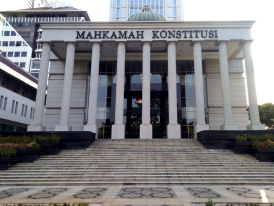



An advocate named Komardin has filed a judicial review with the Constitutional Court (MK) to challenge several provisions in Law No. 14/2008 on Public Information Disclosure (UU KIP), which he argues create ambiguity regarding whether academic diplomas are public or confidential documents.
The petition, registered under case number 174/PUU-XXIII/2025, specifically contests Article 17 (g), Article 17 (h) point 5, and Article 18 paragraph (2)(a) of the law. According to Komardin, Article 17 (g) has led to multiple interpretations − some believe a diploma is a private document, while others argue it is public information, sparking widespread debate.
He pointed out that Article 18 paragraph (2)(a) reinforces the notion that a diploma is confidential, as it requires written consent from the owner before it can be disclosed to the public.
The preliminary hearing took place at the Constitutional Court’s panel courtroom on Friday, October 10, 2025, presided over by Deputy Chief Justice Saldi Isra, along with Constitutional Justices Ridwan Mansyur and Arsul Sani.
Komardin argued that these conflicting legal norms could disrupt public order and undermine the national education system.
“My loss stems from the widespread commotion this issue has caused. It has made our business activities difficult, sparked protests and debates, and even affected economic stability,” Komardin told the panel.
He cited as an example the long-standing controversy over the academic credentials of Indonesia’s 7th President, Joko “Jokowi” Widodo. He claimed that Gadjah Mada University (UGM) refused to provide clarification supported by evidence, which he said only worsened the public confusion.
In a separate legal move, the petitioner has also filed a civil lawsuit at the Sleman District Court, accusing UGM of unlawful conduct for its refusal to release the requested academic documents. Attempts at mediation were also made, but the university maintained its stance that such records are classified under the exemption clauses of the Public Information Law.
Under the contested provisions:
● Article 17 (g) stipulates that public information is exempt if its disclosure would reveal the contents of an authentic deed of a personal nature;
● Article 17 (h) point 5 includes records concerning an individual’s participation in formal or non-formal education;
● and Article 18 paragraph (2)(a) requires the written approval of the person whose confidential information would be disclosed.
In his petition, Komardin urged the Court to reinterpret these articles, arguing that academic documents of public officials, former officials, or individuals paid with state funds should not be classified as confidential.
“Theses and diplomas belonging to public officials should not fall under the category of exempt documents. They should be accessible when their authenticity is questioned by the public,” he asserted.
Already have an account? Sign In
-
Start reading
Freemium
-
Monthly Subscription
20% OFF$29.75
$37.19/MonthCancel anytime
This offer is open to all new subscribers!
Subscribe now -
Yearly Subscription
33% OFF$228.13
$340.5/YearCancel anytime
This offer is open to all new subscribers!
Subscribe now
Set up email notifications for these topics