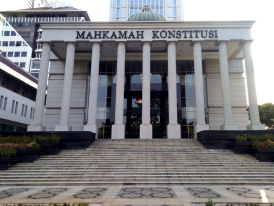



The Constitutional Court (MK) on Tuesday, October 7, 2025 held a follow-up hearing for a judicial review challenging articles related to National Strategic Projects (PSN) in the Omnibus Job Creation Law, inviting the National Human Rights Commission (Komnas HAM) and the National Commission on Violence Against Women (Komnas Perempuan) to provide their opinions.
Komnas HAM Commissioner for Monitoring and Investigation, Saurlin P. Siagian, asked the government to reconsider the development model underpinning PSN, calling it “exclusive, discriminatory, and prone to repeated human rights violations.”
“We hope the Constitutional Court will issue a ruling that is not only corrective but also preventive − directing lawmakers to amend regulations in line with constitutional principles, human rights, and environmental sustainability,” Saurlin said during the hearing in Jakarta.
Komnas HAM presented key findings:
● The PSN provisions in the Job Creation Law are vague and contradict legal certainty principles;
● PSN implementation has violated constitutional rights such as the right to a healthy environment, safety, and property;
● Its top-down governance structure excludes meaningful public participation and often disregards human rights;
● There is a significant gap between PSN’s stated goals and on-the-ground realities, frequently resulting in social conflicts and criminalization of citizens;
● Many projects have caused severe environmental degradation due to ineffective safeguards;
● The excessive involvement of security forces in PSN execution threatens the full realization of human rights;
● Indigenous communities have lost access to ancestral lands and cultural spaces, threatening their identity and sustainability.
“The heavy deployment of security personnel in PSN projects endangers the protection and fulfillment of human rights as a whole,” Saurlin said.
Meanwhile, Komnas Perempuan Chairperson Maria Ulfah Anshor highlighted that PSN activities in the new Nusantara capital city have resulted in gender-based violence (GBV) against women.
“In Nusantara, we’ve documented instances of verbal sexual harassment by security personnel, showing how language itself becomes a tool that undermines women’s sense of safety,” Maria said during the session.
She reported that from 2020 to 2024, Komnas Perempuan recorded 11 PSN-related cases involving gender-based violence and displacement. These include:
● Makassar New Port, South Sulawesi: 300 fisherwomen lost their livelihoods, leading to a spike in domestic violence;
● Bener Dam, Central Java: 334 female farmers lost their farmland;
● Mbay Naga Keo Dam, East Nusa Tenggara: Intimidation by authorities left indigenous women injured physically and socially;
● Poso Hydropower Project, Central Sulawesi: Around 100 women lost access to clean water;
● Poco Leok Geothermal Project, East Nusa Tenggara: Women experienced physical and sexual violence amid project conflicts;
● Vale Indonesia Mine, South Sulawesi: Dozens of women lost access to clean water;
● Merauke Food Estate, South Papua: Indigenous women lost forests and sources of food;
● Indonesian International Islamic University (UIII), West Java: 17 women lost business lands;
● Mandalika Tourism Area, West Nusa Tenggara: Around 70 women lost their businesses due to evictions;
● Rempang Eco-City, Riau Islands: Women suffered physical injuries and land loss;
● Nusantara (IKN), East Kalimantan: Indigenous women faced verbal harassment and land displacement.
The case, registered as No. 112/PUU-XXIII/2025, was filed by the Indonesian Legal Aid Foundation (YLBHI), the Indonesian Forum for the Environment (WALHI), and 19 other petitioners in July 2025. They argue that PSN-related provisions in the Job Creation Law undermine the rule of law as enshrined in Article 1(3) of the 1945 Constitution.
The petition challenges multiple articles − such as Article 3(d), Article 10(u), Article 173(2) and (4), among others − claiming they promote unchecked acceleration and simplification of procedures at the cost of public participation and social justice.
Petitioners argue that vague phrases like “adjustments of various regulations” and “facilitation and acceleration” open the door to abuse of power and exclusion of citizens from meaningful consultation.
They are asking the Court to declare these provisions unconstitutional and unenforceable, ensuring that future national projects uphold transparency, accountability, and the constitutional rights of all citizens.
Already have an account? Sign In
-
Start reading
Freemium
-
Monthly Subscription
20% OFF$29.75
$37.19/MonthCancel anytime
This offer is open to all new subscribers!
Subscribe now -
Yearly Subscription
33% OFF$228.13
$340.5/YearCancel anytime
This offer is open to all new subscribers!
Subscribe now
Set up email notifications for these topics