


Directorate General of New, Renewable Energy, and Energy Conservation at the Ministry of Energy and Mineral Resources (ESDM) reported that there are 679 commercial buildings across Indonesia that need to implement energy management in line with the 500 TOE threshold, in a way that with an energy-saving assumption of 10 percent, potential efficiency savings could reach US$59.9 million annually.
As for government buildings, particularly those registered under PLN tariff categories P2 (government customers with power above 200 kVA) and B2 (large business customers with power ranging from 6,600 VA to 200 kVA), there are 4,751 buildings that need to follow suit.
Assuming an average saving of 18 percent, energy management could potentially reduce costs by up to US$107.5 million annually and decrease emissions by around 1 million tons of CO₂. Therefore, the total annual energy savings from the building sector could reach up to US$168.2 million.
"The Sustainable Energy Transition in Indonesia (SETI) project aims to encourage energy efficiency in buildings, focusing not only on technology but also on behavioral change, strengthening energy management, and building a supportive ecosystem to ensure that the recommendations can be implemented sustainably," Hendra Iswahyudi, Director of Energy Conservation at ESDM ministry, said in a statement on Tuesday, September 30, 2025.
Despite the large energy-saving potential in the building sector, the main challenge lies in financing. High capital expenditures (CAPEX) create a perception of risk, especially for medium-sized companies that need support at a smaller scale. To address this, the government has introduced schemes such as the Energy Savings Guarantee (ESG) by ESCOs and Energy Savings Insurance (ESI) for financial institutions to mitigate investment risks.
"ESCO performance guarantees neutralize the risks of energy efficiency projects, while performance insurance helps financial institutions reduce investment risks," Hendra said.
Fabby Tumiwa, Executive Director of the Institute for Essential Services Reform (IESR), emphasized that energy efficiency in buildings will have a significant impact on reducing national emissions.
"Buildings are the largest consumers of electricity, particularly for heating and cooling. Therefore, improving energy efficiency through sustainable building designs, the use of renewable energy, and energy-saving behaviors of occupants can significantly reduce greenhouse gas emissions," he said.
IESR, along with GIZ as the project coordinator, Yayasan Indonesia CERAH, World Resources Institute (WRI) Indonesia, Fraunhofer Institute, and LPEM UI, form the SETI consortium, which has made Surabaya a model city for building decarbonization. Since early this year, the SETI team has worked with the Surabaya City Government and building managers to conduct a baseline energy consumption study on 295 buildings, with the study expected to conclude by the end of September.
Surabaya has shown a commitment to becoming a low-carbon city by promoting the application of the Green Building concept. One notable example is the Joyoboyo Intermodal Terminal, which earned a Silver rating from the Green Building Council Indonesia in 2020 due to its use of environmentally friendly materials and energy-efficient systems. In addition, various public facilities such as the Regional Development Planning, Research and Development Agency (Bappedalitbang) office, schools, street lighting, and traffic lights have started utilizing solar energy through the installation of solar panels.
This initiative aligns with the principles of Green Buildings, which emphasize energy savings, water efficiency, indoor air quality, and the use of environmentally friendly materials.
"For Surabaya, energy efficiency includes not only governance but also the design and management of buildings to be energy-efficient and healthy for residents. This is a necessity amid growing urban energy consumption, not just a choice," Irvan Wahyudrajat, Head of the Surabaya Bappedalitbang, said.
To strengthen efforts for decarbonizing the building sector, the central government has prepared supporting regulations, including Government Regulation No. 33/2023 on Energy Conservation, Ministerial Regulation No. 3/2025 on Energy Conservation by the Government and Local Governments, and Ministerial Regulation No. 8/2025 on Energy Management.
These regulations require buildings with high energy consumption to implement energy management, report it digitally via the Energy Management Online Reporting (POME), and open access to financing through schemes like Energy Service Companies (ESCO) and Public-Private Partnerships (PPP).
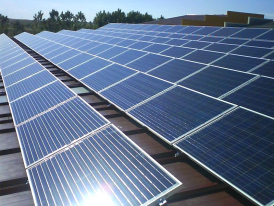
The implementation of these regulations also aligns with the development of renewable energy, including rooftop solar power.
According to Andriah Feby Misna, Director of New and Renewable Energy, the realization of rooftop solar quotas shows a high absorption trend. By July 2024, 728.97 MWp of the 901 MWp quota had been used, while by July 2025, 264.5 MWp of the 333.7 MWp quota was utilized, with a 211 MWp quota set for 2026.
Several best practices have also emerged in the private and educational sectors. For example, Kalla Property has managed to save 21-23 percent in energy annually through retrofitting cooling systems, using LED lights, and improving ventilation. These efforts have cut operational costs by an average of US$119,000 per year while reducing emissions by 1.7 million kg of CO₂.
From the educational side, the Sepuluh Nopember Institute of Technology (ITS) through the Renewable Energy Integration Demonstrator of Indonesia (REIDI) platform has installed a 437 kWp rooftop solar system and a 220 kWh Battery Energy Storage System (BESS). This installation generates 435 MWh of electricity annually and reduces emissions by 482 tons of CO₂, making REIDI a living laboratory for renewable energy innovations.
The SETI project is funded by the Internationale Klimaschutzinitiative (IKI) from the German Government, in cooperation with the Directorate General of New and Renewable Energy and Energy Conservation (EBTKE) of the Ministry of ESDM, and is implemented by a consortium consisting of GIZ, IESR, WRI, Yayasan Indonesia CERAH, Fraunhofer Institute, and LPEM UI. The SETI project focuses on renewable energy and energy conservation through two main themes: decarbonizing industry and buildings.
Already have an account? Sign In
-
Start reading
Freemium
-
Monthly Subscription
20% OFF$29.75
$37.19/MonthCancel anytime
This offer is open to all new subscribers!
Subscribe now -
Yearly Subscription
33% OFF$228.13
$340.5/YearCancel anytime
This offer is open to all new subscribers!
Subscribe now
Set up email notifications for these topics