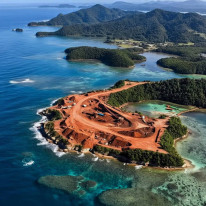



Mining activities in Raja Ampat, Southwest Papua, are drawing criticism amid warnings that nickel extraction in the UNESCO Global Geopark could endanger local tourism, indigenous livelihoods, and fragile marine ecosystems.
According to Auriga Nusantara’s Director of Mining and Energy, Ki Bagus Hadi Kusuma, the impacts of mining go beyond environmental destruction, threatening social cohesion and eroding local culture.
“This area used to rely on tourism, which provided crucial jobs and attracted more than 100,000 visitors in 2023. Now that is under threat. The socio-cultural risks posed by nickel mining to indigenous communities here are extremely high,” Ki Bagus told a press conference in Jakarta on Thursday, September 25, 2025.
Auriga’s data shows that mining in Raja Ampat jeopardizes the livelihoods of 64,141 indigenous and local residents across 3.66 million hectares of the geopark. The risks include weakened customary law, erosion of ancestral practices, and disruption of sacred geographies and rituals.
“Nickel mining undermines customary law, sacred geography, ritual life, and cultural continuity. This represents both a cosmological and existential threat,” Ki Bagus cited.
The group also highlighted severe ecological risks. Around 2,400 coral reefs − roughly 36 percent of the geopark area − are now at high risk of damage from sedimentation linked to mining.
“During our February 2025 visit, we found many popular diving and snorkeling sites showing signs of coral bleaching,” Ki Bagus said.
He cited that bleaching caused by mining sediment has a distinct pattern: “If it’s due to rising sea temperatures, bleaching spreads evenly across an area. But with mining sediment, bleaching starts from the edges of the reef, killing coral gradually toward the center.”
Auriga warned that the conflict between those working in mines and those dependent on fishing and tourism is also escalating. Tourist arrivals to Raja Ampat have already dropped sharply between June and September 2025, the group said.
“If mining continues unchecked, Raja Ampat risks losing its status as a world-class tourism destination,” Ki Bagus stressed.
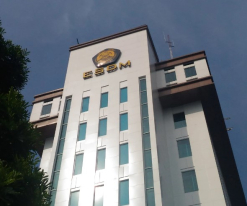
The Indonesian government recently revoked the mining licenses of four companies in Raja Ampat due to environmental violations and the need to safeguard the area. However, earlier this month, one of them − PT Gag Nikel − was granted a new operating license by the Ministry of Energy and Mineral Resources (ESDM), allowing the company to resume operations on Gag Island, Southwest Papua.
Already have an account? Sign In
-
Start reading
Freemium
-
Monthly Subscription
20% OFF$29.75
$37.19/MonthCancel anytime
This offer is open to all new subscribers!
Subscribe now -
Yearly Subscription
33% OFF$228.13
$340.5/YearCancel anytime
This offer is open to all new subscribers!
Subscribe now
Set up email notifications for these topics