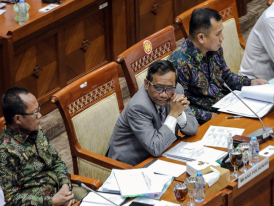



The government’s decision to raise tobacco excise revenue targets to Rp336 trillion (US$20 billion) in the 2026 state budget proposal has drawn criticism from public health advocates, who insisted that fiscal goals should not overshadow the policy’s health objectives.
Chair of the Muhammadiyah Tobacco Control Network (TC Muhammadiyah) and head of the Center for Human and Economic Development (CHED), Roosita MD, said tobacco excise is not merely a fiscal instrument, but a constitutional mandate under Law No. 39/2007 on Excise.
“Excise is imposed on products with negative externalities, particularly health impacts. Raising cigarette excise is therefore a public health necessity, not simply a revenue target. Higher excise reduces affordability, especially for children and adolescents, while also generating state revenue,” Roosita told Indonesia Business Post on Thursday, September 25, 2025.
She described the government’s approach as a “win-win solution” but emphasized that the ultimate goal must remain consumption control.
According to Roosita, the Rp336 trillion excise target is “realistic” only if the government simultaneously simplifies the current multi-tiered tax structure, eliminates price discounts, and strengthens law enforcement.
“Excise should be treated as a pigouvian tax, compensating society for health and economic costs. If consumption and health burdens remain high despite the levy, it means control mechanisms are not working effectively,” she said.
Citing Ministry of Health data, she noted that tobacco-related health costs reach Rp288 trillion (US$17.14 billion) annually, almost equal to projected excise revenue. Meanwhile, only 3 percent of tobacco excise revenue is allocated to regional governments through Dana Bagi Hasil Cukai Hasil Tembakau (DBHCHT), with 97 percent absorbed at the central level.
“This lack of transparency in fund use is a major challenge,” she added.
Illegal cigarettes
Illegal cigarettes, often cheaper and easily accessible to minors, remain a serious issue. TC Muhammadiyah recommends three priority strategies, First, simplifying excise tiers to a maximum of five layers to ease monitoring. Second, Enforcing penalties on manufacturers distributing illicit products. Then, establishing a joint tracking system between the Finance Ministry’s Customs and Excise Directorate and the Trade Ministry.
The government has framed excise policy as a balance between four pillars: revenue, consumption control, labor, and illicit trade.
But Roosita argued the balance is misguided. “The main objective is consumption control. Issues of workers and illicit trade should be addressed with mitigation and exit strategies, not by diluting the health agenda,” she said.
The tobacco industry has long claimed that tax hikes threaten jobs. But Roosita countered the argument, pointing out that mechanization, not taxation, has already displaced many workers.
“BPS (Statistics Indonesia) data shows around 1.46 million workers depend on the industry. But large manufacturers increasingly use machines, reducing labor demand. This structural shift requires government-led exit strategies for affected workers,” she said.
To ensure excise policy meets both fiscal and public health goals, TC Muhammadiyah urges the government to. First, Increase excise across all cigarette types to make them less affordable. Second, Gradually reduce excise tiers to 3–5 categories. Third, Strengthen enforcement against illicit trade using the mandated 10 percent Tobacco excise revenue sharing fund (DBHCHT)allocation,
Fourth, ensure local excise revenue is used strictly for tobacco control. Fifth, adopt a multiyear excise framework to guarantee consistent annual increases.
“The government must remember that tobacco excise is not just about income. It is a fiscal tool to save lives and reduce the nation’s long-term economic burden,” Roosita concluded.
Already have an account? Sign In
-
Start reading
Freemium
-
Monthly Subscription
20% OFF$29.75
$37.19/MonthCancel anytime
This offer is open to all new subscribers!
Subscribe now -
Yearly Subscription
33% OFF$228.13
$340.5/YearCancel anytime
This offer is open to all new subscribers!
Subscribe now
Set up email notifications for these topics