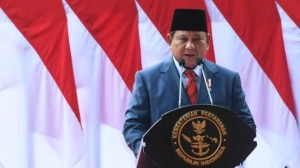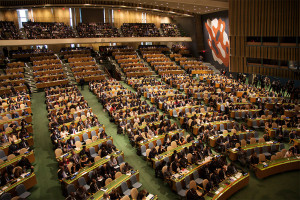



Clean energy campaigners have praised President Prabowo Subianto’s recent statement at the United Nations General Assembly that reaffirms Indonesia’s commitment to the Paris Agreement, but suggested that it be followed with more ambitious targets and energy transition policies, from laws and regulations to the National Electricity Supply Business Plan (RUPTL).
Agung Budiono, Executive Director of CERAH, expressed concern that Indonesia's current energy sector regulations do not reflect President Prabowo’s Paris Agreement commitment.
“From Government Regulation (PP) No. 40/2025 on National Energy Policy (KEN) to the latest RUPTL, the policies still heavily favor fossil energy. The share of fossil energy in KEN is set at 26.1-32 percent, while the RUPTL plans to add 16.6 gigawatts (GW) of gas and coal-fired power plants over the next decade,” Agung said as quoted in a astatement on Thursday, September 25, 2025.
According to the International Energy Agency (IEA), the world must achieve net-zero emissions by 2050. They warn that this goal cannot be achieved if there is any expansion in coal, gas, and oil sectors.
"President Prabowo had previously stated his support for 100 percent renewable energy within the next decade, and if this target is met, Indonesia could reach net-zero by 2050. Therefore, the government must revise all energy and electricity policies to align with this commitment," Agung cited.
He pointed out that certain energy transition technologies, such as biomass co-firing and carbon capture and storage/carbon capture, utilization and storage (CCS/CCUS), should be removed from policy plans, as they do not eliminate fossil fuel dependence or the associated carbon emissions. For instance, the biomass mix in KEN projected for 2050 at 7.4-7.6 percent would only extend the use of coal-fired power plants, hindering progress toward increasing renewable energy in Indonesia's energy mix.
Abdurrahman Arum, Executive Director of Clean Transition, added that another policy in urgent need of revision is the continued use of coal for downstream industries. The government is still permitting mining companies to build new coal-fired power plants for smelting industries, which contradicts Indonesia’s commitment to reducing emissions and achieving net zero emission (NZE) before 2060.
"The government cannot claim commitment to NZE while simultaneously allowing new coal plants for smelting industries. This contradiction must stop to make Indonesia’s energy transition more consistent and credible," Abdurrahman said.
Wicaksono Gitawan, Program and Policy Manager at CERAH, highlighted the stark contrast between President Prabowo’s statement and a recent remark by U.S. President Donald Trump, who dismissed climate change and green energy as a fraud.
"Trump’s statement, made just before President Prabowo’s speech, disregards the global scientific consensus. 2024 was the hottest year on record, and Trump’s misguided comments ignore collective global efforts," Wicaksono noted.
In Indonesia, the climate crisis, exacerbating extreme weather, is expected to worsen food security. A CERAH study (2022) found that even a one-meter rise in sea levels could submerge over 130,000 hectares of coastal rice fields, potentially causing a loss of one million tons of rice production, enough to feed five million people. This could severely impact Indonesia’s food resilience, which President Prabowo emphasized in his speech.
"If we follow Trump’s incorrect logic – that climate change is a fraud – the stakes for Indonesia are enormous. We are already witnessing the direct impacts of the climate crisis, from crop failures to flooding," Wicaksono concluded.
Already have an account? Sign In
-
Start reading
Freemium
-
Monthly Subscription
20% OFF$29.75
$37.19/MonthCancel anytime
This offer is open to all new subscribers!
Subscribe now -
Yearly Subscription
33% OFF$228.13
$340.5/YearCancel anytime
This offer is open to all new subscribers!
Subscribe now
Set up email notifications for these topics