


Indonesia Business Post
Indonesia is showing steady progress in its energy transition, marked by renewable adoption, rising investment commitments, and digital integration. These findings come from the Asia Pacific Energy Transition Readiness Index 2025 conducted by ABB, a survey of more than 4,000 business leaders across 12 Asia-Pacific countries and 10 industries.
While the results highlight positive developments, the survey does not always break down findings by company size or revenue scale. Most responses reflect views from large energy users in capital-intensive sectors, meaning the data may not represent smaller domestic companies.
Renewable energy adoption
According to the survey, 40 percent of companies in Indonesia already source more than half of their energy needs from renewables, far higher than the regional average of 25 percent. The report specifies that this trend is strongest in the Energy & Power Generation sector (60 percent) and Data Centers (55 percent). However, it does not clarify adoption rates among smaller or medium-sized firms, which may still rely heavily on conventional energy sources.
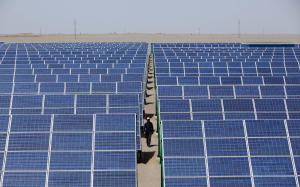
Solar energy dominates Indonesia’s renewable mix, with 75 percent of respondents identifying it as their primary source. This is followed by hydropower (60 percent), geothermal (44 percent), green hydrogen (42 percent), wind (39 percent), and biomass (28 percent). Looking ahead, 87 percent of organizations in Indonesia expect renewable usage to increase by more than 20 percent within the next five years, well above the Asia-Pacific average of 77 percent.
Investment commitments
The survey also highlights strong financial commitment to the transition. It found that 86 percent of companies in Indonesia plan to allocate more than 10 percent of their capital expenditure (CAPEX) to energy transition initiatives over the next five years. The largest commitments are concentrated in the Energy & Power Generation sector (100 percent), Oil & Gas (98 percent), and Data Centers (98 percent).
However, the report does not provide detail on the investment capacity of smaller and medium-sized businesses, which may face significant financing challenges compared to larger players.
Technological innovation and AI
Technological innovation emerges as a key accelerator, with 70 percent of Indonesian respondents viewing it as the most powerful driver of the transition, slightly higher than the regional average of 65 percent. Within this, 47 percent believe that artificial intelligence (AI) and automation can be transformational tools to optimize energy systems and accelerate decarbonization, compared with 32 percent regionally.
While this reflects strong optimism, the survey does not clarify which industries are best positioned to adopt AI solutions, suggesting that much of the enthusiasm may be concentrated among energy-intensive sectors with greater digital maturity.
Digitalization and infrastructure modernization
Digitalization is also seen as an important opportunity. Nearly 40 percent of Indonesian respondents identify automation and digital solutions among the top three untapped opportunities in the country’s energy market. When asked about priorities, 47 percent chose digitalization, followed by 33 percent for automation and 20 percent for electrification.
These numbers are higher than regional averages, yet the survey does not indicate whether this focus is spread across industries broadly or concentrated mainly in grid operators and large industrial firms that have the capital to modernize infrastructure.
Human capital and green skills
Workforce readiness is another recurring theme. Around 30 percent of Indonesian organizations see an urgent need to strengthen their capacity to meet energy transition targets. Interestingly, large sectors such as Energy & Power Generation, Oil & Gas, and Data Centers expressed lower levels of concern (15–16 percent), which suggests that smaller players may feel the shortage of green talent more acutely.
Collaboration and partnerships
Collaboration is highlighted as one of the most critical success factors. A quarter of Indonesian respondents named public–private partnerships as one of the three biggest untapped opportunities in the energy transition. In terms of areas where collaboration could accelerate progress, respondents pointed to increasing private sector investment, cross-regional government cooperation on grid infrastructure, and stronger government incentives and subsidies. While these are promising areas, the report does not specify which industries are most open to collaboration, leaving investors to assess case by case where the most viable partnerships may emerge.
Challenges and risks for investors
While Indonesia’s momentum is strong, investors should also note the survey’s limitations and the broader risks:
- Sector Bias: Many of the most positive results come from energy-intensive industries and large corporates, not SMEs.
- Policy Execution: Regulatory clarity is improving, but implementation has historically been slow or uneven.
- Infrastructure Bottlenecks: Indonesia’s archipelagic geography and uneven grid capacity complicate nationwide renewable integration.
- Financing Barriers: Smaller firms may struggle to access affordable capital for transition projects.
- Skills Gap: The shortage of “green talent” is real, even if larger companies feel it less.
- Technology Dependence: High reliance on imported digital and automation solutions could raise long-term cost and supply risks.
Outlook for investors
The survey suggests that Indonesia is well-positioned to accelerate its energy transition, particularly in sectors like power generation, oil & gas, and data centers where adoption and investment are strongest. However, investors should exercise caution: the optimistic figures may not represent the full economy. For foreign investors, sector-by-sector due diligence and close attention to regulatory follow-through will be essential in assessing opportunities in Indonesia’s energy market.
Already have an account? Sign In
-
Start reading
Freemium
-
Monthly Subscription
20% OFF$29.75
$37.19/MonthCancel anytime
This offer is open to all new subscribers!
Subscribe now -
Yearly Subscription
33% OFF$228.13
$340.5/YearCancel anytime
This offer is open to all new subscribers!
Subscribe now
Set up email notifications for these topics