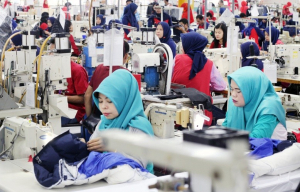



The Indonesian Textile Association (API) said the government’s decision to extend the income tax incentive (PPh 21 borne by the government) will have only a minimal impact on the performance of the national textile industry.
Under the scheme, workers in labor-intensive industries earning up to Rp10 million (US$645) per month are exempt from paying income tax. API Chairman Jemmy Kartiwa acknowledged that the extension would provide some relief, but stressed that weak demand both at home and abroad remains the textile and textile product (TPT) sector’s biggest challenge.
“This policy will certainly help the national textile industry, but not in a significant way. Nonetheless, we appreciate the government for extending it,” Jemmy told Katadata.co.id, on Thursday, September 18, 2025.
He urged the government to adopt broader measures to stimulate purchasing power, particularly by creating more jobs in the domestic market. According to him, higher employment would raise household incomes, which in turn would boost secondary and tertiary spending − benefiting the domestic TPT industry. Jemmy also recommended that the government push for lower lending rates.
Bank Indonesia cut its benchmark rate for the fifth time this year to 4.75 percent on Wednesday, September 17, 2025. As a result, deposit rates now stand at 3.75 percent, while lending rates hover around 5.5 percent. Jemmy argued that lower loan rates would ease household financial burdens.
“Lower lending rates mean cheaper mortgages and car loans. This will reduce household installments and free up more spending, part of which could go toward textile products,” he said.
API Executive Director Danang Girindrawardana added that the tax incentive extension could prevent mass layoffs in 2026, noting that the main goal of the policy is to protect workers’ purchasing power and support labor-intensive industries. However, he expressed less optimism about growth prospects for the TPT industry next year.
“The government is maintaining its budget efficiency measures in 2026, including cutting spending on uniforms. We believe domestic and export demand will remain highly volatile next year. Honestly, our current outlook is not conservative, but pessimistic,” Danang said.
Already have an account? Sign In
-
Start reading
Freemium
-
Monthly Subscription
20% OFF$29.75
$37.19/MonthCancel anytime
This offer is open to all new subscribers!
Subscribe now -
Yearly Subscription
33% OFF$228.13
$340.5/YearCancel anytime
This offer is open to all new subscribers!
Subscribe now
Set up email notifications for these topics