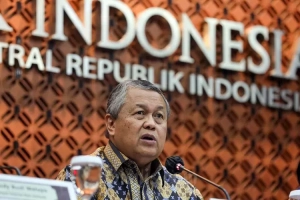


The Indonesian Central Bank (BI) has reported Rp217.10 trillion (US$13.2 billion) in Government Securities (SBN) purchases as of September 16, 2025, a move BI Governor Perry Warjiyo claimed as a reflection of close synergy between monetary and fiscal policies.
“This includes purchases in the secondary market and a debt-switching program with the government amounting to Rp160.07 trillion,” Perry told a media conference upon the completion of BI’s Monthly Board of Governors Meeting on Wednesday, September 17, 2025.
Perry emphasized that secondary market purchases are carried out according to market mechanisms.
“They are conducted in a measured, transparent manner, consistent with monetary programs aimed at maintaining economic stability and preserving monetary policy credibility,” he said.
The bond purchases are part of BI’s broader liquidity expansion efforts. The central bank has also reduced the outstanding position of its monetary instrument, the Central Bank Rupiah Securities (SRBI), from Rp916.97 trillion at the beginning of 2025 to Rp716.62 trillion as of September 15, 2025.
According to Perry, BI continues to strengthen its policy mix to stimulate economic growth while safeguarding stability.
“Monetary policy is being pursued through lowering the BI Rate, stabilizing the rupiah exchange rate, and expanding monetary liquidity,” he noted.
Monetary measures are further supported by Macroprudential Liquidity Incentives (KLM) and accelerated payment system digitalization to encourage economic activity.
“BI is reinforcing the implementation of KLM to boost credit growth and bank financing,” Perry explained.
As of the first week of September 2025, total KLM incentives stood at Rp384 trillion, distributed across banking groups as follows:
- State-owned banks (BUMN) & national private commercial banks (BUSN): Rp170 trillion each;
- Regional development banks (BPD): Rp38.5 trillion;
- Foreign bank branches (KCBA): Rp5.7 trillion.
The incentives are directed toward priority sectors, including:
- Agriculture;
- Real estate;
- Public housing;
- Construction;
- Trade and manufacturing;
- Transportation and warehousing;
- Tourism and creative economy;
- Micro, small, and ultra-micro enterprises (MSMEs);
- Green sectors.
Already have an account? Sign In
-
Start reading
Freemium
-
Monthly Subscription
20% OFF$29.75
$37.19/MonthCancel anytime
This offer is open to all new subscribers!
Subscribe now -
Yearly Subscription
33% OFF$228.13
$340.5/YearCancel anytime
This offer is open to all new subscribers!
Subscribe now
Set up email notifications for these topics