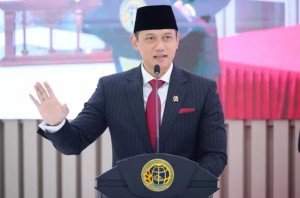



Coordinating Minister for Infrastructure and Regional Development, Agus Harimurti Yudhoyono, said one of the government’s current priorities is to build low-emission connectivity infrastructure, through expansion of public transportation and acceleration on electric vehicle (EV) industry development.
Agus stressed that EV development is critical since the transportation sector is one of the biggest contributors to pollution, particularly in Jakarta. At the same time, boosting public transport use will directly reduce air pollution nationwide.
“We need policies that can lower carbon emissions. Public transport must be affordable, fast, accessible, and in some cases free for certain groups. This must be actively pursued, along with vehicle electrification,” Agus said during Katadata SAFE 2025 in Jakarta on Thursday, September 11, 2025.
Rachmat Kaimuddin, Deputy for Basic Infrastructure Coordination at the Coordinating Ministry, highlighted that the national strategy aims to increase EV adoption to ease fiscal pressures from fuel subsidies.
He noted that domestic fuel consumption, at 295 million barrels last year, is still heavily dependent on imports, while most of Indonesia’s energy exports consist of coal − accounting for nearly 75 percent of total energy exports.
Between 2022 and 2024, fuel subsidies have averaged around Rp135 trillion (US$8.2 billion) annually. “If we cut fuel subsidies immediately, it would create unrest. But if we make fuel irrelevant, people may not protest when subsidies are phased out,” Rachmat cited.
He added that EV adoption is also influenced by the nature of cars as consumer goods. “We cannot deny that there’s demand for private vehicles, and people want to own them,” he said.
To address this, the government is prioritizing local EV production. Rachmat acknowledged that imports of completely built-up (CBU) EVs have surged in recent years due to tax incentives, rising ninefold from about 2,000 units in 2023 to more than 18,000 units last year.
Imports are expected to jump over 250 percent this year, reaching 65,000 units, bringing total EV sales to around 100,000 units − with 35,000 projected to come from local production.
However, Rachmat emphasized that all EV sales will shift to domestic production starting next year, as the government will no longer extend incentives for CBU imports.
“Yes, EVs are still largely imported, but import permits have only been granted to companies committed to building EV factories in Indonesia,” he said.
Already have an account? Sign In
-
Start reading
Freemium
-
Monthly Subscription
20% OFF$29.75
$37.19/MonthCancel anytime
This offer is open to all new subscribers!
Subscribe now -
Yearly Subscription
33% OFF$228.13
$340.5/YearCancel anytime
This offer is open to all new subscribers!
Subscribe now
Set up email notifications for these topics