


Indonesia Business Post
President Prabowo Subianto expressed deep sorrow and anger on Friday, August, 29, following the death of an online motorcycle taxi driver, Affan Kurniawan, who was killed after being struck by a police tactical vehicle (Rantis) during a protest in Central Jakarta on Thursday night, August 28, 2025.
In a televised statement, Prabowo said the government would take full responsibility for the victim’s family while also demanding accountability from officers involved in the incident.
“On behalf of the government of the Republic of Indonesia, I extend my deepest condolences to the family of the late Affan Kurniawan. The government will guarantee their livelihood and provide special attention to his parents and siblings,” the president said.
“I was shocked and disappointed by the excessive actions of the personnel involved. I have instructed that this incident must be thoroughly and transparently investigated, and those proven to have violated procedures will face the harshest legal consequences,” he added.
Affan’s death
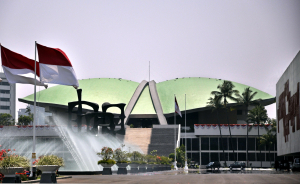
The night of August 28, 2025, in Jakarta was meant to be another chapter of protests outside the House of Representatives. But it ended with the death of Affan Kurniawan, a 21 year old online motorcycle taxi driver, who was crushed under the wheels of a Brimob armored vehicle, Baracuda.
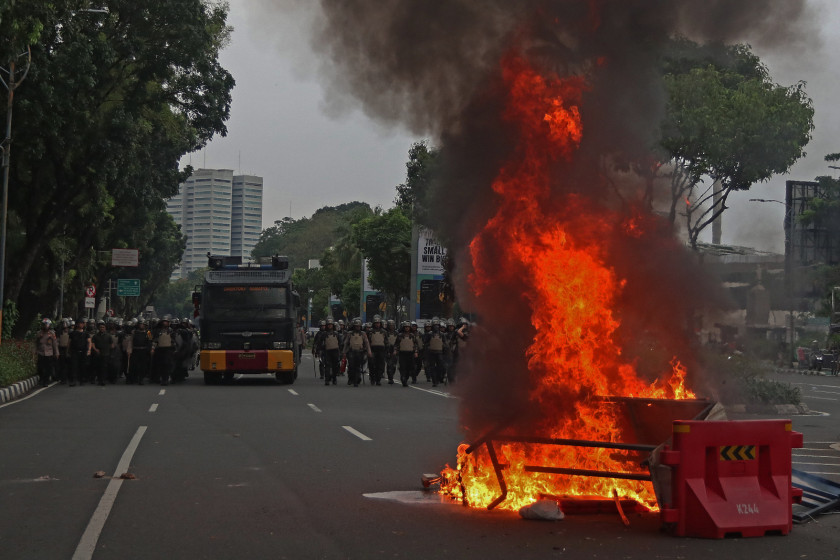
Affan’s story ordinary yet deeply human has since become the face of grief and anger that continues to engulf the capital. He was not a frontline protester, but his life was cut short amid a storm of tear gas, firecrackers, and clashes that turned Pejompongan and Senen areas into fields of chaos.
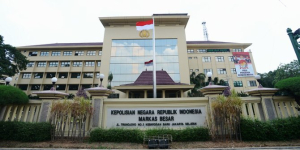
By midnight, his fellow riders and hundreds of residents marched spontaneously to the Brimob headquarters in Kwitang, Central Jakarta. They demanded answers, refusing to leave despite clouds of gas that hung in the air.
One police post went up in flames; buses were rerouted; and Jakarta woke up on Friday morning to traffic jams and a sense of unease.
Calls for accountability
The death of Affan prompted rare consensus in the House of Representatives (DPR) Speaker Puan Maharani extended her condolences and urged a transparent probe. “Police must fully investigate this heartbreaking incident and ensure it is done in the open,” she said on Friday, noting that another driver, Moh Umar Amarudin, had been injured during the clashes.
Seven officers including a commissioner and several rank-and-file members have since been detained by the police’s internal affairs division. National Police Chief Gen. ListyoSigit Prabowo publicly apologized, acknowledging the force’s responsibility.
According to reports, seven police officers were arrested in connection with the incident involving a motorcycle taxi driver.
The seven officers are Police Commissioner C, First Inspector M, First Brigadier R, First Brigadier D, First Brigadier M, Baraka Y, and Baraka J. Those involved are currently undergoing questioning by the National Police Headquarters' Internal Affairs (Propam) Division and the Mobile Brigade Corps' Propam Division.
For Affan’s community, however, the apology was not enough. His fellow riders draped his photo on their jackets and helmets, turning their grief into a mobile protest.
The protests that week were never just about police violence. They had been building since August 25, driven largely by labor unions and civil society groups who accused lawmakers of betraying the people. The grievances range from soaring living costs to lawmakers’ generous allowances, which many argue stand in stark contrast with the economic hardships of ordinary Indonesians.
Yet, the House’s response has been minimal. Apart from Puan’s statement, no official delegation has come out to meet the protesters. Instead, controversial remarks by Nasdem legislators Ahmad Sahroni calling for the arrest of “anarchic” demonstrators, including minors fueled further outrage.
“The protests are clearly directed at parliament, but DPR refuses to engage directly. Their silence only deepens the distrust. When representatives shy away from accountability, they lose their very legitimacy as people’s representatives,” a researcher from the Indonesian Parliament Watchdog (Formappi), Lucius Karus, said.
On Friday morning, Aug. 29, as rocks clashed against riot shields in Kwitang, the underlying issue seemed larger than a single death. Affan’s tragedy crystallized a growing chasm between the state and its citizens, one marked by distrust, anger, and an overwhelming sense of alienation.
The protests may fade in days, but the legitimacy crisis facing parliament and the accountability questions haunting the police will not be as easily dispersed as tear gas in the air.
Already have an account? Sign In
-
Start reading
Freemium
-
Monthly Subscription
20% OFF$29.75
$37.19/MonthCancel anytime
This offer is open to all new subscribers!
Subscribe now -
Yearly Subscription
33% OFF$228.13
$340.5/YearCancel anytime
This offer is open to all new subscribers!
Subscribe now
Set up email notifications for these topics