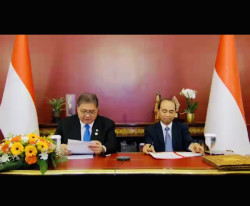



The United States has agreed in principle to exempt Indonesian palm oil, cocoa, and rubber from a 19 percent import tariff imposed under President Donald Trump’s trade measures earlier this month, said Coordinating Minister for the Economny Airlangga Hartarto on Tuesday, August 26, 2025.
The removal, however, will only take effect once both sides reach a final agreement, which has yet to be scheduled, said the Chief of Indonesian Trade Negotiators in an interview with Reuters.
“The essential point of the exemption has been agreed for products not produced in the U.S., such as palm oil, cocoa, and rubber. The tariff will be zero or close to zero,” Airlangga said.
Trade-offs and investment talks
During the negotiations, Airlangga said government discussed potential U.S. investment in fuel storage facilities in partnership with Indonesia’s sovereign wealth fund (Danantara) and State energy companyPertamina.
Indonesia, the world’s largest palm oil exporter and a key rubber supplier, was among the first countries to strike a preliminary tariff deal with Trump in July. However, it was later subjected to the same 19 percent duties faced by Thailand and Malaysia, and slightly below Vietnam’s 20 percent.
To secure relief, Indonesia has offered billions of dollars in investment in the U.S., alongside purchases of American crude oil, LPG, aircraft, and agricultural products. Jakarta also pledged near-zero tariffs on nearly all U.S. goods entering its market.
The United States Embassy in Jakarta declined to comment.
Economic outlook
Airlangga said clarity on U.S. tariffs, combined with progress in ongoing free trade agreement talks with the European Union, could boost investor confidence and help Indonesia reach its 5.4 percent growth target in 2026, up from around 5 percent this year.
“They bring an optimistic perception from global markets because most investors are seeking certainty, and Indonesia is one of the countries that provides global certainty,” he said.
The government is also courting foreign investment to expand downstream processing of key commodities, replicating its success in attracting Chinese capital to nickel projects.
The government has highlighted new opportunities in silica sand processing, including solar panel and semiconductor wafer production.
Already have an account? Sign In
-
Start reading
Freemium
-
Monthly Subscription
20% OFF$29.75
$37.19/MonthCancel anytime
This offer is open to all new subscribers!
Subscribe now -
Yearly Subscription
33% OFF$228.13
$340.5/YearCancel anytime
This offer is open to all new subscribers!
Subscribe now
Set up email notifications for these topics