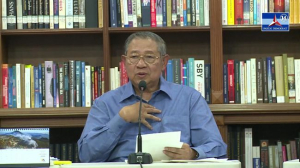


Sixth president of Indonesia, Susilo Bambang Yudhooyono (SBY), held a public lecture on Wednesday, July 30, 2025, commenting on world affairs in the spotlight and voicing concerns on pressing global issues.
A major focus of SBY’s speech, titled "World Disorder and the Future of Our Civilization”, was the potential for a large-scale global war, particularly in the Asia-Pacific region. He warned that military tensions in various parts of the world, especially in this region, could exacerbate an already fragile situation.
"We must remain vigilant, as continued miscalculations could lead to a large-scale war capable of destroying civilization. East Asia and the Asia-Pacific region are critical points, and we must do everything possible to prevent a greater conflict," he said.
He pointed out several hot spots, including the relations between the United States and China and the increasingly tense situation in the South China Sea. According to him, if major powers continue to escalate military tensions, there is a risk of a war that could involve many countries and undermine the civilization that has been built.
"Mistakes in calculating power could lead to an unexpected war that will inevitably expand into a large-scale conflict," he added, stressing the need for more intensive diplomatic efforts to ease these tensions.
New threat to human values
SBY also expressed his concerns about the impact of technological progress, particularly artificial intelligence AI, which he believes could replace humans in decision-making roles. While acknowledging the benefits of technologies like AI, he emphasized the significant risks if these technologies are used without clear ethical and moral guidelines.
"AI, which lacks emotion, empathy, or morality, could replace many human functions. If this happens, we risk eroding our human values. Technology without empathy could make us lose our humanity," SBY said. He pointed out that as technology advances, it is essential to have strong ethical guidelines to prevent the erosion of long-held human values.
He further reminded that the advancement of technology should not ignore its impact on society, especially in the context of war, social injustice, and humanitarian crises.
"If we allow technology to develop without control, we may end up with a divided and unjust world," he warned.
Climate change and global responsibility
In his lecture, SBY also highlighted the urgent issue of climate change, building on his past experience as Indonesia’s climate champion. He emphasized that climate change requires a much stronger global commitment.
SBY pointed out that while many countries recognize the urgency of the issue, many have yet to take significant actions. He called on developed nations to take the lead in reducing carbon emissions, while also urging developing nations to play a more active role in mitigating climate change.
"As a developing country, Indonesia and others must contribute more in addressing the climate crisis. However, developed nations must lead. They must take responsibility for the majority of emissions currently in the atmosphere," SBY emphasized, adding that every country must commit to reducing harmful environmental impacts for the sake of the planet's sustainability.
He also reminded that solutions to climate change cannot rely on one country or one sector.
"This is a global issue that requires international cooperation. If we do not act together, the consequences will be felt by all nations, both rich and poor," he warned.
Food security
Food security was another key issue SBY addressed in his lecture. He expressed concern about global dependence on international food supply chains and how this could affect social and economic stability in the future. According to him, food security is a critical issue that cannot be ignored by any country.
"Food security is an issue that must be addressed through global cooperation. Countries must ensure that they have sustainable food systems and are not overly dependent on imports. Additionally, we need to leverage more advanced and environmentally-friendly agricultural technologies to ensure adequate food supplies for the entire world," SBY said.
He also noted that food distribution inequality could trigger social and political tensions in various countries.
"If food prices are too high, people will struggle. If they are too low, farmers will lose out. We must find a balance that is fair to all parties," the former president said, highlighting the need for attention to this issue in global economic policies.
In closing, SBY called on the world to unite in addressing the increasingly complex global challenges. He stressed that no single country can tackle these major issues alone.
"The world must act now to prevent further suffering and ensure a better future for the generations to come. We must collaborate to face the challenges of climate change, food security, and the growing threats of conflict," he concluded.
Already have an account? Sign In
-
Start reading
Freemium
-
Monthly Subscription
20% OFF$29.75
$37.19/MonthCancel anytime
This offer is open to all new subscribers!
Subscribe now -
Yearly Subscription
33% OFF$228.13
$340.5/YearCancel anytime
This offer is open to all new subscribers!
Subscribe now
Set up email notifications for these topics