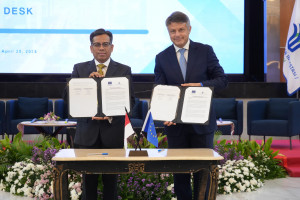



Minister of Investment and Downstream/Head of the Investment Coordinating Board (BKPM), Rosan Perkasa Roeslani, underscored Indonesia's commitment to achieving net-zero emissions by 2060, with a set of ambitious goals, in particular on energy transition and a government projection that 76 percent of electricity will come from renewable energy sources − geothermal, solar, wind, and hydropower.
“We are fully committed to achieving net-zero emissions by 2060. One of our key strategies is transitioning to renewable energy, and we’re on track for substantial progress in the coming years,” Rosan told a press conference on Tuesday, July 29, 2025.
Indonesia’s geothermal sector is drawing international attention. With vast reserves of geothermal energy, the country is positioning itself as a major player in the global energy market. The government’s focus on these areas is in line with the international push for cleaner energy and sustainable practices.
Renewable energy potential
Indonesia’s renewable energy potential is being tapped into with a significant focus on geothermal energy. As one of the countries with the largest geothermal reserves in the world, Indonesia is directing investments toward this sector.
The government is also fostering technological advancements, with strong emphasis on clean energy solutions and the development of electric vehicle (EV) battery ecosystem, which is reliant on minerals like nickel.
“The focus on geothermal energy is aligned with our goals of expanding the renewable energy sector. We are also developing the full EV battery ecosystem, from nickel mining to battery production and recycling,” Rosan said.
In addition to geothermal, the government is investing in other renewable energy sources, such as wind and solar power, with substantial financial commitments aimed at expanding capacity and infrastructure. These investments are expected to contribute significantly to Indonesia’s efforts in reducing its carbon footprint and achieving sustainable economic growth.
FDI leads the way
A significant portion of investment in Indonesia comes from foreign sources, which accounted for 68.6 percent or Rp99.1 trillion (about US$6 billion) of the total. The dominance of foreign investments in sectors like renewable energy and mining highlights Indonesia’s appeal to global investors, particularly those looking to enter the growing market for green technologies and clean energy solutions.
Foreign investors, particularly from Singapore, Hong Kong, China, the United States, and Malaysia, are playing a key role in financing these projects.
“We continue to see strong investment from key partners like Singapore and China. However, we are also seeing growing interest from other countries, which signals a positive shift in our investment landscape,” Rosan said.
The influx of foreign capital facilitates technology transfers, knowledge sharing, and the establishment of critical partnerships to develop high-value industries. For example, the development of the EV battery sector requires the latest technological advancements, and foreign investors are bringing in the expertise necessary to ensure these projects are completed successfully.
Sign of growing strength
While foreign investments continue to lead, domestic investments (PMDN) are showing a strong upward trend, accounting for 54.1 percent of the total investments in the first half of 2025. This shift highlights the increasing strength of local businesses and their growing commitment to Indonesia’s long-term economic stability.
Rosan emphasized that the combination of foreign and domestic investments is crucial for Indonesia’s sustainable growth. “We are seeing a positive trend where local businesses are investing more heavily. This combination of domestic and foreign investments is vital for a balanced and resilient economy,” he said.
Minerals, agriculture, and fisheries
Indonesia's mineral sector, particularly nickel, has seen a significant influx of investment, driven by the growing global demand for electric vehicle batteries. As the world shifts toward sustainable transportation, Indonesia's strategic position as one of the largest producers of nickel offers immense opportunities for growth.
However, the government is not solely focused on minerals; it is also prioritizing investments in other sectors such as agriculture, fisheries, and forestry.
“We are pushing for more value-added products in sectors like agriculture and fisheries. For instance, Indonesia is the second-largest producer of seaweed globally, and we are looking to expand this industry further. We also see great potential in aquaculture and the production of various fish species,” Rosan concluded.
Already have an account? Sign In
-
Start reading
Freemium
-
Monthly Subscription
20% OFF$29.75
$37.19/MonthCancel anytime
This offer is open to all new subscribers!
Subscribe now -
Yearly Subscription
33% OFF$228.13
$340.5/YearCancel anytime
This offer is open to all new subscribers!
Subscribe now
Set up email notifications for these topics