


The latest trade agreement between the Indonesian and U.S. governments exempts certain technology products from the requirement to meet the Domestic Component Level (TKDN), but not entirely.
Such an exemption was part of the recent announcement made by U.S. President Donald Trump over a trade agreement with Indonesia, which among others an agreement to eliminate TKDN requirement for U.S. products, including exempting U.S. companies and goods from local content requirements.
Susiwijono Moegiarso, Secretary of the Coordinating Ministry for the Economy, said that the goods proposed for TKDN adjustments include data centers and technology products.
"They only requested that these two types of goods be exempted because production capacity in Indonesia is limited. This means that imports from the U.S. will remain subject to import regulations, and technical ministries will continue to monitor them," Susiwijono said at the Katadata Policy Dialogue on Thursday, July 24, 2025.
One of the issues of concern is data centers and digital devices, such as iPhones. However, Susiwijono did not explicitly mention which companies are included in the exemption.
Previously, the Ministry of Industry banned the sale of the iPhone 16 because it did not meet the TKDN requirements. Apple is known to have chosen to fulfill its TKDN obligations through investment schemes in research and development (R&D) rather than building a hardware factory directly.
Currently, TKDN certification remains an absolute requirement for technological devices such as mobile phones, computers, tablets, and medical devices.
On the other hand, Apple has reportedly recently committed to building a US$1 billion (Rp16.3 billion) production facility in Batam, Riau Islands.
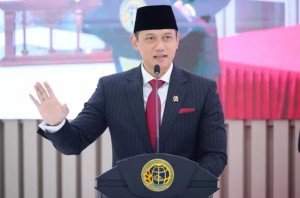
Agus Gumiwang Kartasasmita, Minister of Industry, emphasized that the TKDN relaxation is still under negotiation. He suggested that TKDN is an important requirement for technological devices to obtain distribution permits in Indonesia.
Currently, medical devices must have a minimum TKDN of 25 percent in order to be sold in the domestic market, while the minimum TKDN for technological devices such as mobile phones, computers, and tablets is 35 percent. However, for products other than these two, there is no requirement for businesses to obtain a TKDN certificate.
"So, we need to know which goods we want to relax the TKDN regulations for. It's possible that the goods we want to adjust their TKDN don't need to comply with it," Agus said at the GAIKINDO Indonesia International Auto Show 2025 on Thursday, July 24, 2025.
On the other hand, the government's negotiating team will continue to consider the nation's interests and existing regulations. Agus also said that the trade agreement between the two countries, which aims to reduce tariffs to 19 percent, does not change the TKDN regulations.
He emphasized that TKDN compliance is mandatory for goods to enter the government procurement market; currently, the minimum TKDN for goods sold for government needs is 40 percent.
"If a company considers selling its products using state funds or public taxes to be unimportant, it doesn't need to apply for a TKDN certificate," he said.
Already have an account? Sign In
-
Start reading
Freemium
-
Monthly Subscription
20% OFF$29.75
$37.19/MonthCancel anytime
This offer is open to all new subscribers!
Subscribe now -
Yearly Subscription
33% OFF$228.13
$340.5/YearCancel anytime
This offer is open to all new subscribers!
Subscribe now
Set up email notifications for these topics