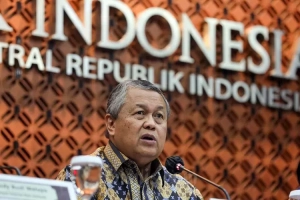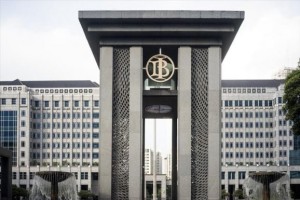



Analysts have carefully responded to the Indonesian Central Bank’s (BI) three consecutive benchmark rate cuts in 2025 although they are broadly seen as positive signal for stock performance of banking sector players.
They warned that the tailwinds may not be strong enough to outweigh the persistent structural and sentiment-driven challenges facing the industry.
Capital market observer Budi Frensidy noted that despite lower borrowing costs, the performance of the banking sector remains subdued.
“As of June 2025, annual credit growth stands at just 7.77 percent, the lowest since March 2022,” Budi said as quoted on Monday, July 21, 2025.
“Typically, credit growth outpaces GDP growth by 3 to 4 times, but right now it’s only about 1 to 2 times,” he added, while attributing the sluggishness to a combination of factors including decelerating economic growth, weakening consumer purchasing power, sluggish business activity, and rising non-performing loan (NPL) ratios.
Investor caution
Investor sentiment has also been dampened by growing concerns over state-owned banks being assigned extensive government mandates, such as their involvement in the newly launched Koperasi Merah Putih (Red-and-White Cooperatives) program, which aims to develop over 80,000 village and urban cooperatives nationwide.
“This is adding to the list of investor worries especially among foreign investors who are now more cautious towards State-owned banks,” Budi said.
The resulting risk aversion is reflected in capital flows. BI data shows that foreign investors withdrew Rp1.91 trillion from the equity market between July 14 and 17.
Year-to-date foreign net sales in the domestic financial market as of July 17, 2025 reached Rp47.11 trillion, including Rp58.01 trillion in equities and Rp48.07 trillion in Bank Indonesia Rupiah Securities (SRBI). Only the government bond (SBN) market saw a positive inflow of Rp 59.97 trillion.
As a result, banking stocks have been under pressure. On Monday, July 21, 2025, shares of PT Bank Rakyat Indonesia (BRI) closed at Rp 3,830 per share, marking a year-to-date decline of 6.13 percent.
Bank Mandiri and Bank Negara Indonesia (BNI) fared worse, with their shares down 17.89 percent and 6.44 percent, respectively. Private banks, such as BCA and CIMB, Niaga also saw declines of 12.66 percent and 1.16 percent.
The broader financial index, which tracks 106 listed financial companies, closed at 1,375.22 on the same day down 2.71 percent from the start of the year.
Global and domestic catalysts
Despite headwinds in banking, market optimism is rising in other sectors, with the Jakarta Composite Index (IHSG) showing a promising recovery. The index closed at 7,312 last Friday, gaining 3.75 percent for the week and moving within a range of 7,071 to 7,402.
Retail Equity Analyst at Indo Premier Sekuritas, Indri Liftiany Travelin Yunus, expects the IHSG to trade between support at 7,150 and resistance at 7,400 in the near term.
“Positive sentiment from BI’s rate cut, the easing of foreign outflows, and the potential for strong second-quarter earnings are fueling investor confidence,” she said in a statement, on Monday.
Only two sectors posted losses last week, with consumer cyclicals dragging the index down by 3.59 percent as investors rotated out of defensive plays. On the upside, the technology sector surged 19.88 percent, powered by a 60 percent weekly rally in shares of DCII, prompting the Indonesia Stock Exchange to issue an Unusual Market Activity (UMA) label.
Markets also reacted positively to the U.S. announcing a reduction in import tariffs for Indonesian goods from 32 percent to 19 percent and speculation over Morgan Stanley Capital International’s (MSCI) upcoming rebalancing, which may include stocks like BREN, PTRO, and CUAN.
Looking ahead to July 21–25, Indri highlights several key events that could influence market sentiment: a speech by U.S. Federal Reserve Chair Jerome Powell, which may offer insights into future Fed policy, and the release of July’s U.S. Manufacturing PMI Flash expected to fall from 52.9 to 52.4.
Domestically, the upcoming earnings season is likely to serve as a near-term driver for stock prices. “With the possibility of further rate cuts by BI in the second half (H2) of 2025, and 54 percent of global investors betting on a Fed rate cut in September, market momentum remains constructive,” Indri said.
“The combination of easing foreign outflows, accommodative monetary policy, and improving macro sentiment presents compelling buy opportunities particularly in fundamentally strong stocks that are poised for breakout,” she concluded.
Already have an account? Sign In
-
Start reading
Freemium
-
Monthly Subscription
20% OFF$29.75
$37.19/MonthCancel anytime
This offer is open to all new subscribers!
Subscribe now -
Yearly Subscription
33% OFF$228.13
$340.5/YearCancel anytime
This offer is open to all new subscribers!
Subscribe now
Set up email notifications for these topics