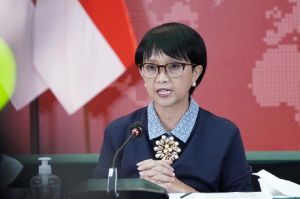


United Nations Secretary-General’s Special Envoy on Water, Retno Marsudi, has warned that the current global water crisis poses a serious threat to food security.
In her address to stakeholders and agricultural leaders, Retno emphasized that food issues cannot be separated from water issues, and that cross-sectoral action is urgently needed to prevent a dual crisis in the future.
“Water is life. There is no life without water. And when we talk about food security, we cannot ignore water security,” Retno said in her remarks on Thursday, July 17, 2025.
She highlighted that 72 percent of the world’s freshwater is currently used for agriculture, yet the world is facing three major water-related crises: too much water (flooding), too little water (drought), and water being politicized.
“One in four people in the world faces water scarcity. And by 2050, it is projected that three-quarters of the global population will be affected by drought. That is a staggering figure,” she stressed.
She noted that these challenges are compounded by climate change and the lack of investment in water infrastructure. According to World Bank data, only 1.2 percent of global public spending is allocated to water infrastructure, and private sector participation remains extremely low − only around 2 percent.
Retno also linked water and food issues to the 2030 Sustainable Development Goals (SDGs), especially Goal 2: zero hunger. However, she cautioned that global progress remains far behind expectations.
“Right now, only 17 percent of SDG targets have been achieved. Meanwhile, nearly 10 percent of the global population is suffering from hunger, and 2.8 billion people cannot access healthy food,” she said.
As a way forward, Retno outlined three key steps. First, the world must move beyond a business-as-usual approach.
“We must act decisively and accelerate the transformation of the food system to make it more efficient, inclusive, resilient, and sustainable. We must produce more with less − generate more food using less water,” she said.
Second, she called for the implementation of integrated water resource management and innovative solutions as the core of food system policies. She emphasized the importance of water-responsive agriculture, which is particularly relevant for Indonesia as an agrarian country.
Third, she underlined the need for accurate data and information, as well as the use of technology such as artificial intelligence, to support better decision-making in the water and agriculture sectors.
“If the data we have is inaccurate, then our responses will also be ineffective. This is a major challenge for developing countries,” Retno said.
She concluded by reaffirming that water is the key to four essential pillars: better production, better nutrition, a better environment, and a better life for all − leaving no one behind.
Already have an account? Sign In
-
Start reading
Freemium
-
Monthly Subscription
20% OFF$29.75
$37.19/MonthCancel anytime
This offer is open to all new subscribers!
Subscribe now -
Yearly Subscription
33% OFF$228.13
$340.5/YearCancel anytime
This offer is open to all new subscribers!
Subscribe now
Set up email notifications for these topics